The Development of Urban Planning Curricula in Korea : Influences of Contemporary Research Trends
 ; Kwon, Youngsang****
Abstract
This study examines how major urban planning research topics in South Korea and abroad have shaped the development of urban planning education curricula over time. Using Latent Dirichlet Allocation (LDA) topic modeling, archival research, and content analysis, the study explores shifts in research focus and identifies how these changes were reflected in educational content. The findings indicate that earlier research emphasized residential development and regional planning, whereas more recent studies focus on smart cities, environmental planning, and land use. These evolving topics were reflected in curricular developments across three phases: establishing foundational concepts, addressing global urban challenges, and responding to domestic urban issues. The study finds that the integration of contemporary research into curricula often lags by several years, highlighting the need for a more responsive curriculum development strategy. Based on these findings, the study proposes two key approaches: integrating global urban issues into the early stages of curriculum design and anticipating domestic urban challenges to proactively shape future educational content. These strategies are expected to enhance the responsiveness of planning education to both global discourse and national urban issues.
Keywords:
Curriculum, Education, History, LDA, Urban Planning키워드:
교육과정, 교육, 역사, 도시계획Ⅰ. Introduction
Urban and regional planning plays a crucial role in achieving sustainable development, particularly when it is grounded in local conditions. Effective planning must address a range of spatial, socio-economic, and technological challenges at the local level, requiring the expertise of skilled professionals trained through structured and context-specific education (Babalik-Sutcliffe, 2002; Dawkins, 2016; Thomas and Bertolini, 2014; Woodhouse, 2011). What distinguishes urban planning from many other disciplines is its function as a coordinating field—one that integrates knowledge and practices across domains such as engineering, public policy, real estate, environmental science, and community development. Its core strength lies not in disciplinary specialization but in the ability to synthesize diverse perspectives and translate them into actionable spatial and policy interventions. This integrative nature of urban planning further underscores the importance of cultivating professionals who are not only technically competent but also deeply attuned to the specific conditions and needs of their local contexts. Nevertheless, many countries—particularly in the Global South—still lack planning curricula that adequately reflect their own socio-spatial realities and developmental priorities (Diaw et al., 2002; Peña, 2023; Watson and Odendaal, 2013).
South Korea presents a compelling case for examining the evolution of urban planning education. Since the Korean War, the country has experienced rapid economic development and urbanization, resulting in significant planning challenges such as excessive centralization (Kang, 1998), traffic congestion (Kim and Han, 2012; Sun et al., 2017), urban heat islands (Kim and Baik, 2005; Kim and Song, 2015), and skyrocketing housing costs (Kim and Han, 2012; Xiao and Park, 2010). When the first urban planning department was established in 1965 (Dong-A University, 2025), Korea’s GDP per capita was just USD 108.7. By 2022, it had surged to USD 34,757.7 (World Bank Group, 2022). This dramatic growth created urgent demand for planning professionals but offered limited time for systematic development of education to meet evolving urban needs.
While previous studies have acknowledged the importance of planning education, few have investigated how urban planning curricula have changed in response to shifts in societal or research priorities. Some scholars have explored the role of higher education in regional development (Cortese, 2003; Shaw and Allision, 1999; Sterling, 2004) and examined planning pedagogy in specific national contexts, such as Mexico (Peña, 2023), India (Chettiparamb, 2006), China (Tian, 2016), and various African countries (Odendaal, 2012). These studies have often focused on institutional arrangements, pedagogical strategies, or curriculum content at a given point in time, with limited attention to long-term development processes. In the South Korean context, Ju (1985) offered a statistical overview of planning departments in the 1980s, and Choi and Kim (2018) discussed the history and future agenda of planning education and research. However, neither study investigated how curricula have evolved over time in connection with broader research or societal trends.
This study addresses that gap by analyzing how urban planning curricula in South Korea have developed in response to both domestic and international research trends. It makes three key contributions. First, the research applies big data analysis—specifically Latent Dirichlet Allocation (LDA) topic modeling—to examine research trends from a dataset of 116,603 academic articles, making it one of the few studies to link educational change to large-scale research patterns. Second, the study combines this big data analysis with content analysis of major planning textbooks to trace how educational content has evolved across time. Third, the study offers policy-relevant insights for curriculum reform in rapidly urbanizing countries by focusing not only on the structure of planning education but also on its timing and responsiveness to emerging issues.
Importantly, the findings from South Korea’s experience can serve as a practical reference for developing countries that are in the process of designing or revising their own urban planning curricula. As many of these countries face similarly compressed timelines for urbanization and institutional development, South Korea’s case provides valuable lessons on how educational systems can evolve in response to research trends, global discourse, and local urban challenges. The methodology and findings of this study may inform curriculum design in contexts where planning education is still emerging or lacks alignment with current urban realities.
The study addresses the following research questions:
- • Q1: How have research topics evolved in the Republic of Korea and internationally over time?
- • Q2: How has planning education developed in the Republic of Korea?
- • Q3: Have the planning curricula in the Republic of Korea been influenced by contemporary domestic and international research topics?
By investigating these questions, the study aims to identify ways to make urban planning education more responsive to both global challenges and national needs, ultimately contributing to the development of skilled professionals capable of addressing future urban problems.
Ⅱ. Research Framework
1. Research Methodology
The study is designed to examine the evolution of urban planning education curricula in South Korea in relation to changing research trends. Understanding this development is vital to nurturing future urban professionals who can respond to emerging planning challenges, especially in rapidly urbanizing contexts. Although urban planning education has evolved significantly in Korea, few studies have explored the influence of research trends in curricular content. To address this gap, the following hypotheses are proposed:
- • H1: Urban planning curricula evolve in response to changing planning issues, influenced by geographical, environmental, policy, and societal factors.
- •H1.1: In the early stages of planning education, global trends are more strongly reflected than national or regional characteristics.
- •H1.2: As curricula mature, they increasingly incorporate domestic urban challenges.
To examine these hypotheses, the study employs two complementary and methodologically connected approaches: Latent Dirichlet Allocation (LDA) topic modeling and content analysis.
First, to analyze shifts in research focus over time, Latent Dirichlet Allocation (LDA) is employed. LDA is a widely unsupervised machine learning technique for extracting latent topics from large volumes of unstructured text data (Blei et al., 2003). Unlike traditional keyword frequency or citation analysis, LDA allows for the detection of implicit thematic structures in large corpora. This makes it particularly suitable for longitudinal analysis of thousands of academic articles—such as the 116,603 papers used in this study—where thematic shifts are not easily captured by simple metadata.
LDA was selected over other methods, such as manual coding or supervised classification, because of its scalability, objectivity, and ability to uncover nuanced patterns without prior labeling. More importantly, LDA provides a data-driven map of research trends that serves as a reference point for evaluating whether and when such trends are reflected in educational content.
Additionally, the study employs content analysis to track how textbook content has evolved over time. Content analysis is a systematic technique for deriving valid and replicable inferences from texts (Drisko and Maschi, 2016). This method is widely used in curriculum studies and allows for both qualitative and quantitative assessment of thematic trends (Ali and Doan, 2006; Eltinge and Roberts, 1993; Hamin and Marcucci, 2013; Keles and Yazan, 2023; Pezzoli and Howe, 2001; Sen et al., 2017; Yu et al., 2022). In this study, seven editions of the Introduction to Urban Planning textbook, published from 1991 to 2016 by the Korea Planner’s Association, were analyzed to identify changes in pedagogical focus and content structure.
The integration of LDA topic modeling and content analysis allows for a longitudinal and comparative analysis. While LDA reveals what topics dominated academic research in different periods, content analysis shows which of those topics were actually adopted into planning education and when. This connection is central to evaluating the temporal relationship between knowledge production and knowledge dissemination. This methodological linkage strengthens the study’s ability to trace causal or correlational patterns and to make informed recommendations about how planning curricula can become more responsive to ongoing research and real-world challenges.
2. Research Data
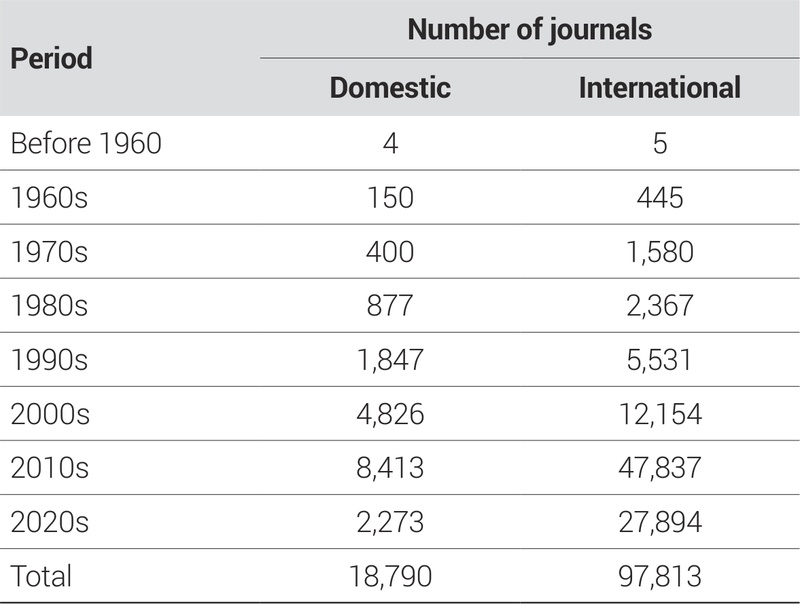
The research data used in this study are structured into two main components. First, to identify contemporary urban issues, the study analyzes the titles of both Korean and international academic research papers. For the domestic dataset, 18,790 scholarly articles published in South Korea between 1922 and 2022 were collected using the keyword “urban planning (도시계획)” from RISS (Research Information Sharing Service), operated by the Korea Education and Research Information Service. For the international dataset, 97,813 academic articles published between 1908 and 2022 were retrieved from the Web of Science using the keyword “urban planning”(Table 1). These datasets were used to detect temporal trends in research topics through topic modeling.

Number of domestic/international journals analyzed by year
Second, the study compares these identified research trends with the content of planning education to examine how contemporary urban issues have been reflected in pedagogy. To conduct this comparison, seven editions of Introduction to Urban Planning (「도시계획론」), the principal textbook published by the Korea Planner’s Association, were reviewed. As the primary teaching material developed by South Korea’s largest urban planning society, this textbook provides a comprehensive view of the evolution of planning curricula in the country. The editions used in this study were published in 1991, 1998, 2000, 2003, 2008, 2009, and 2016.
Ⅲ. Research Results
1. Analysis of Planning Issues
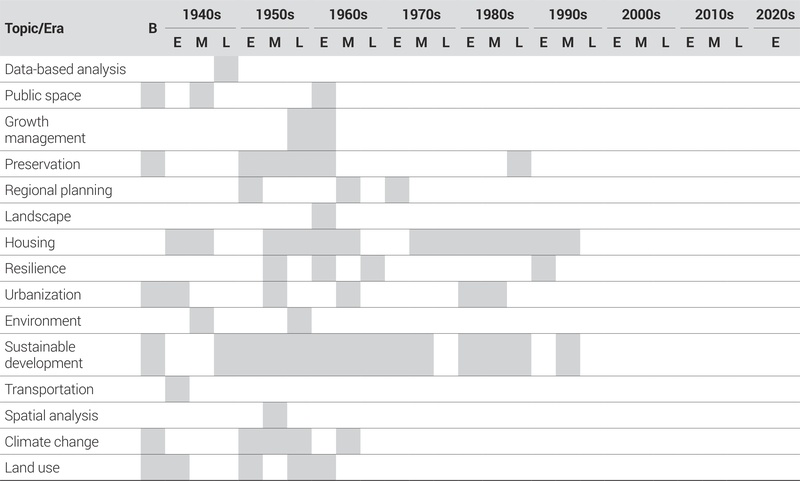
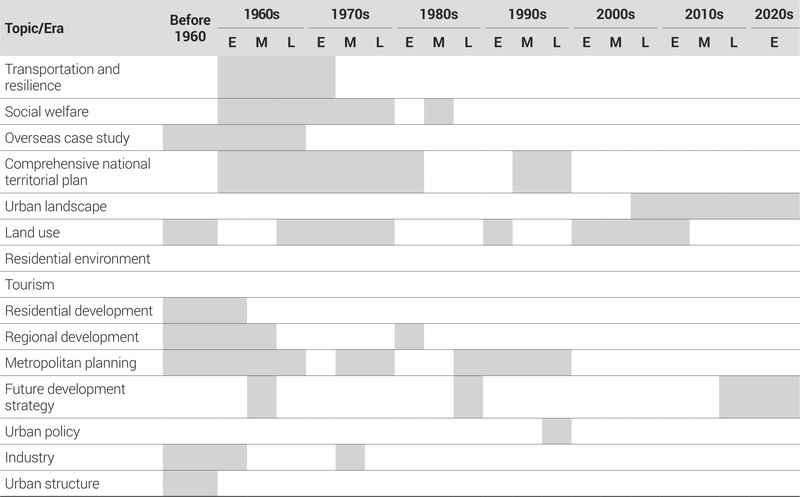
To identify how urban planning issues have evolved over time, the study analyzed the titles of 116,603 academic papers using Latent Dirichlet Allocation (LDA) topic modeling. The dataset included 18,790 papers from South Korea (1922-2022) and 97,813 international papers (1908-2022). Based on perplexity and coherence analysis, fifteen distinct topics were identified (see <Tables 2 and 3>). All Korean keywords were translated into English by the authors.
<Tables 2 and 3> present the topics that exceeded 10 percent of total research activity during at least one period over the decades. Each decade was divided into three sub-periods—early, mid, and late—to provide a more granular view of topic trends. The marked cells indicate the dominant research theme in each time segment, illustrating how the focus of planning research has shifted over time in South Korea and globally.
In the early decades of planning research in South Korea, dominant topics included “transportation and resilience,” “social welfare,” and “overseas case studies.” The topic “transportation and resilience” accounted for over 10 percent of research from the 1960s to the early 1970s, but declined afterward. “Social welfare” emerged in the early 1960s and remained above 10 percent through the late 1970s, peaking again in the mid-1980s. The popularity of “overseas case studies” declined significantly after the 1960s.
Other topics, such as “comprehensive national territorial plans” and “land use,” remained influential for longer periods. “Comprehensive national territorial plans” attracted sustained interest from the 1960s to the early 1980s and again in the mid to late 1990s. “Land use” was a recurring theme from before the 1970s and notably exceeded 10 percent in both the late 1970s-1970s and early 2000s-2010s.
By contrast, topics like “urban landscape” only began to gain traction in the late 2000s. Themes such as “residential development,” “tourism,” and “residential environment” were briefly dominant before the 1990s. “Regional development” peaked in the mid-1960s and early 1980s, while “metropolitan planning” was actively researched until the 1990s. The theme “future strategy,” which includes smart city discourse, saw episodic increases in the mid-1970s, late 1980s, and again from the late 2010s onward. “Urban policy” briefly surpassed 10 percent in the late 1990s, and “industry” was a key theme until the early 1970s, with a short resurgence in the mid-1970s.
Until the early 1990s, four or more topics often exceeded the 10 percent threshold within a given period, indicating a concentration of research on a small set of issues. Since the mid-1990s, however, only one to three topics have typically surpassed that threshold, suggesting growing diversification and specialization in planning research. For example, fields like transportation planning have evolved into more differentiated subdomains.
<Table 3> outlines changes in international urban planning research. Between the late 1990s and late 2010s, no single topic exceeded the 10 percent threshold, reflecting increasing thematic dispersion. Notably, “land use”—a dominant theme until the early 1960s—re-emerged as a major topic in the 2020s.
15 research topics and change in planning research trends worldwide (1923-2022) (B (before 1940), E (early), M (mid), L (late))
15 research topics and change in planning research trends in Korea (1937-2022) (E (early), M (mid), L (late))
Four topics showed persistent presence across multiple decades: “preservation,” “housing,” “sustainable development,” and “climate change.” “Preservation” was prominent prior to the 1940s and again from the 1950s to the early 1960s. “Housing” appeared intermittently from the 1940s through the mid-1990s. “Sustainable development” was a core topic until the mid-1990s, while “climate change” began gaining traction from the mid-1980s and remained prominent into the 1990s.
Several topics saw short-lived popularity before the 1970s, including “data-based analysis,” “public space,” “growth management,” “landscape,” “environment,” “transportation,” and “spatial analysis.” “Regional planning” was widely researched from the 1950s to early the 1970s. The theme of “resilience” also gained attention from the mid-1950s to the 1960s and again in the early 1990s. Lastly, “urbanization” was actively studied in short bursts until the mid-1980s.
2. Evolution of Planning Education Content
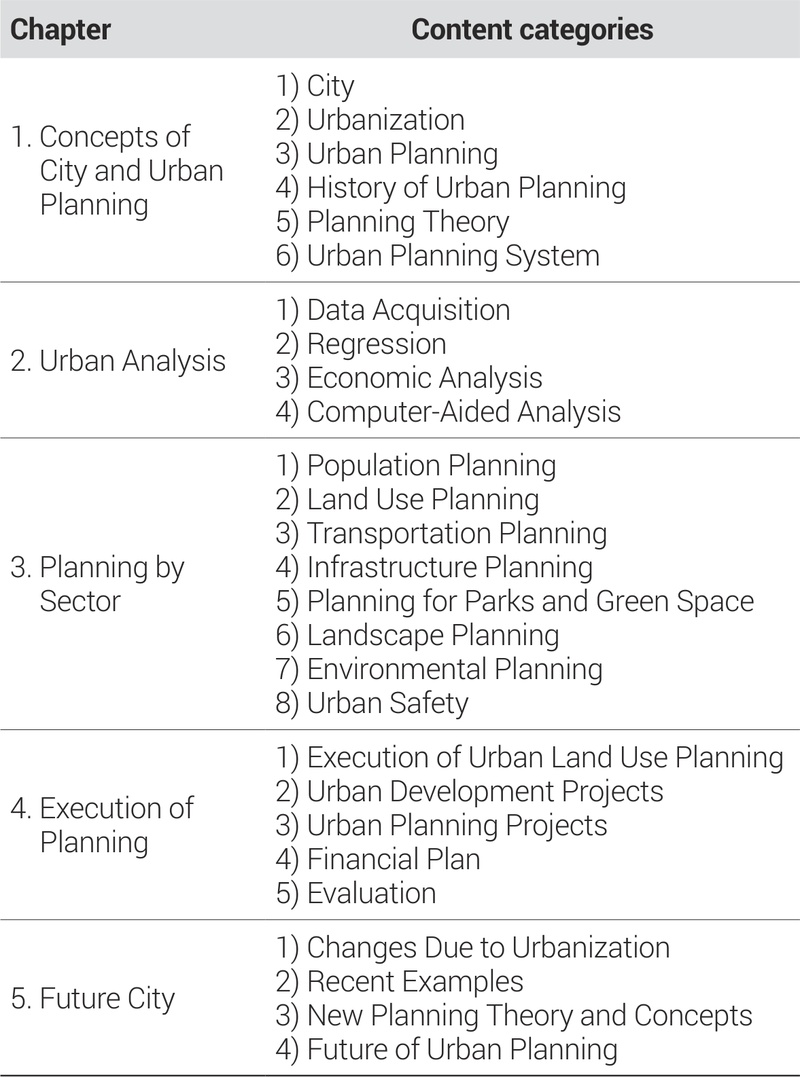
The content of seven different editions of Introduction to Urban Planning (「도시계획론」), published by the Korea Planning Association, were analyzed using content analysis. The textbook is structured into five chapters: Concepts of City and Urban Planning, Urban Analysis, Planning by Sector, Execution of Planning, and Future Cities. <Table 4> presents a comparative summary of the content distribution across all editions.
Contents of Introduction to Urban Planning (「도시계획론」)
The analysis revealed a gradual decline in the proportional emphasis on the chapters Planning by Sector and Concepts of City and Urban Planning. This trend aligns with the diversification of research topics observed in South Korea beginning in the late 1990s—a shift that began globally as early as the 1970s. This thematic broadening is evidenced by the reduction in the number of dominant topics (those exceeding 10 percent of research output), which fell from more than ten to fewer than three over time.
In contrast, the chapters Urban Analysis and Future Cities have gained prominence in more recent editions, reflecting a growing emphasis on data-driven diagnostics and forward-looking urban strategies. The Execution of Planning chapter has remained relatively stable in its proportion throughout all editions. Notably, over the 25-year span covered by the seven editions, the relative order of chapter proportions has remained consistent: Planning by Sector was the largest section, followed by Concepts of City and Urban Planning, Execution of Planning, Urban Analysis, and Future Cities.
3. Relationship between Planning Curricula and Research Trends
This study investigates how domestic and international research trends have influenced the development of urban planning education in South Korea. To measure the timing of topic adoption, a minimum time unit of half a decade was used. In <Figure 1>, the size of each circle represents the time gap between the emergence of a topic in research and its inclusion in the curriculum; larger circles indicate a longer delay. Yellow circles represent topics derived from domestic research trends, blue circles indicate those based on international research, and green circles reflect topics that appeared in both.
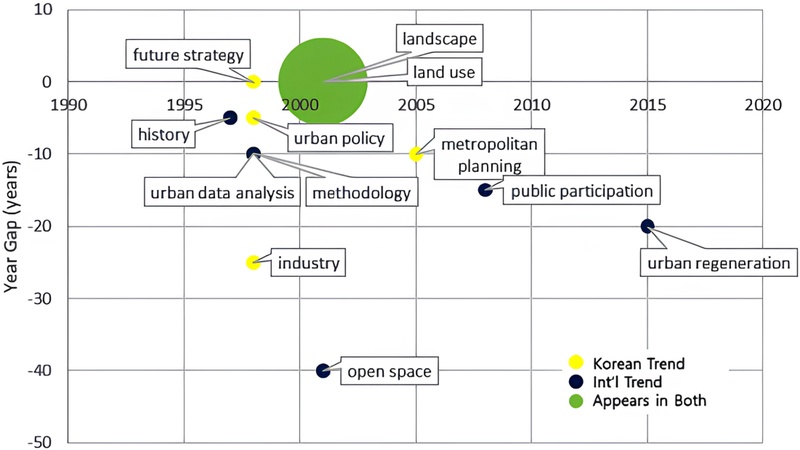
Comparison of topics in the textbook and research trends
A key finding is that no topic was introduced in planning curricula before it emerged in the research discourse. In the 2000s, several long-established international research themes were incorporated into South Korean textbooks: public space, which had been widely studied globally since the 1960s; public participation, prominent since the 1980s; and resilience, a theme dating back to the 1970s in global literature.
Notably, the topic of landscape emerged significantly later in both South Korean research and curricula compared to international trends. However, once it appeared in domestic research, it was incorporated into education relatively quickly. The theme of urban landscape entered Korean academic discourse approximately two decades after its initial emergence in international literature. Interest in this area began in the mid-1990s, coinciding with South Korea’s post-growth economic stabilization (Eichengreen et al., 2012; Piazolo, 1995), particularly regarding height restrictions in urban design. This momentum was briefly disrupted by the 1997 Asian financial crisis (Chang, 1998; Kwon, 2001), but resumed in the mid-2000s when urban design became a political priority. During the fourth local election, Seoul Mayor Oh Se-hoon promoted the “Design Seoul” initiative as a campaign pledge (Lee, 2015), which triggered the inclusion of the landscape theme in urban planning education. This case illustrates that the inclusion of urban landscape topics in the curricula was driven more by economic recovery and local policy initiatives than by international academic trends.
Similarly, land use has been a long-standing topic in both international and domestic research. However, its integration into South Korean planning education occurred roughly four decades after it became prominent globally. Prior to the 1990s, land use was not considered a major academic or pedagogical focus in South Korea. However, rapid urbanization, escalating transportation issues, and large-scale developments such as new towns elevated the relevance of “efficient land use.” Political discourse in the early 1990s—such as the Democratic Liberal Party’s call for more effective land use (Yonhap News, 1992)—and national initiatives like the New Five-Year Plan (1993-1997), which emphasized development and utility (Wolf, 1962), catalyzed both research and education in this area.
In contrast, topics related to engineering, industry, and technology were adopted into curricula with comparatively shorter delays after appearing in domestic research. Themes such as digital infrastructure, future strategy, and smart technologies gained prominence quickly. This is partly due to the significant role digital technologies have played in South Korea’s economic development (Jung et al., 2013). Initiatives such as the Digital New Deal (Cruz, 2020; Yoon, 2021) and Smart City policies (Chang et al., 2022; Yang et al., 2020) have helped accelerate the integration of these themes into planning education.
The relatively faster curricular adoption of technology-related topics may be explained by the Law of Accelerating Returns, which posits that technological change is exponential rather than linear (Kurzweil, 2001). As digital and technological disciplines evolve at an increasingly rapid pace, educational systems must adapt more swiftly to remain relevant. Compared to sectors such as land use or urban design—which involve slower-moving institutional, legal, and spatial change—technology-driven fields place more immediate demands on curriculum responsiveness.
However, not all topics exhibited clear developmental trajectories. For instance, themes such as financial planning and evaluation did not display a consistent pattern of emergence in either research or curriculum development. This may suggest a lack of thematic integration or reflect the dispersion of relevant research across other disciplines, such as economics, finance, or real estate studies. This observation aligns with the inherently interdisciplinary nature of urban planning, which often draws upon and adjusts insights from a range of specialized fields. As a result, topics related to finance and evaluation may be more prominently developed under the purview of economics or financial planning disciplines rather than within core urban planning literature.
IV. Conclusion
This study examined the evolution of urban planning education curricula in the Republic of Korea in relation to domestic and international research trends. Using a combination of Latent Dirichlet Allocation (LDA) topic modeling and content analysis of textbook editions, the study traced how research-driven knowledge production has shaped pedagogical development over time.
The findings reveal a three-phase trajectory in Korea’s urban planning education. In the initial phase, curricula focused on foundational concepts and global theories, particularly those aligned with international development discourse. In the second phase, globally emerging planning topics—such as sustainability and environmental design—gradually appeared in the curriculum, although often with a considerable time lag. In the most recent phase, beginning in the 2010s, domestic challenges such as smart city development and urban regeneration have begun to feature more prominently in educational content, indicating a shift toward addressing Korea’s specific urban realities.
These patterns suggest that urban planning education in Korea has responded to research trends both internationally and locally, but not always in a timely or balanced way. Especially for newer, fast-evolving issues like smart cities, digital infrastructure, and urban resilience, more agile curriculum updates are needed. Additionally, for the aforementioned technology-related emerging issues, an integrated approach from various disciplines is required, considering the urban planning’s characteristic of adjusting the balances between various sectors. To enhance the responsiveness of planning education to both global discourse and national urban challenges, we recommend the establishment of integrated curriculum review systems that are regularly informed by ongoing academic research and supported by institutional mechanisms for updating textbooks.
One of the key contributions of this study is methodological: by combining big data analysis with content-focused qualitative methods, it enables a cross-validating exploration of the link between knowledge production and dissemination. In doing so, the research offers practical insights not only for Korea but also for developing countries where urban planning education is still being designed or is underdeveloped. In such contexts, Korea’s experience offers a valuable precedent for how to structure a responsive and evolving planning curriculum in line with both international best practices and context-specific needs. Particularly, the study demonstrates the importance of integrating emerging research themes into education early—rather than decades later—so that future professionals are better equipped to address pressing challenges.
Despite its contributions, the study has several limitations. Most notably, the dataset used for topic modeling was constructed using the keyword “urban planning (도시계획).” As a result, relevant research from closely related fields—such as transportation, environmental studies, real estate, or public health—that did not explicitly use this keyword may have been excluded. This limitation is especially relevant in a multidisciplinary field like urban planning, where critical insights are often published outside core disciplinary boundaries. Additionally, the topic modeling process did not include English-language abbreviations such as TOD (Transit-Oriented Development) and CPTED (Crime Prevention Through Environmental Design), due to limitations in bilingual data handling. Furthermore, the individual interests of textbook authors may have influenced chapter content, despite editorial oversight by planning associations. Finally, this study did not account for external factors—such as legislation, planning implementation cases, or political agendas—that may also shape curriculum development.
Future research should address these gaps by incorporating broader keyword sets across disciplines and analyzing external influences on planning pedagogy. Comparative studies across countries would also be beneficial for understanding how different national trajectories shape the evolution of urban planning education. Such research would deepen our understanding of how to build curricula that not only reflect contemporary knowledge but also prepare planning professionals for the complex, interdisciplinary demands of future cities.
Acknowledgments
This study was conducted by supplementing a part of an M.E. research project of Minkyung Cho in the Department of Civil and Environmental Engineering, Seoul National University, Republic of Korea.
This study was supported by the Korea Ministry of Land, Infrastructure, and Transport (MOLIT) as part of the Innovative Talent Education Program for Smart City. This study was conducted by the Ministry of Land, Infrastructure, and Transport (RS-2022-00143404), the Ministry of Education of the Republic of Korea, and the National Research Foundation of Korea (NRF-2021S1A5C2A03087287), and the Ministry of Science and ICT of the Republic of Korea and the National Research Foundation of Korea (RS-2023-00278550). This study was supported by the Integrated Research Institute of Construction and Environmental Engineering, the Institute of Engineering Research, and the Research Grants for Asian Studies funded by Seoul National University Asia Center(SNUAC) in 2021 (0448A-20210080), Seoul National University.
References
-
Ali, A.K. and Doan, P.L., 2006. “A Survey of Undergraduate Course Syllabi and a Hybrid Course on Global Urban Topics”, Journal of Planning Education and Resaerch, 26(2): 222-236.
[https://doi.org/10.1177/0739456X06291500]

-
Babalik-Sutcliffe, E., 2002. “Urban Rail Systems: Analysis of the Factors Behind Success”, Transport Reviews, 22(4): 415-447.
[https://doi.org/10.1080/01441640210124875]
- Blei, D.M., Ng, A.Y., and Jordan, M.I., 2003. “Latent Dirichlet Allocation”, Journal of Machine Learning Research, 3(Jan): 993-1022.
-
Chang, H.J., 1998. “Korea: The Misunderstood Crisis”, World Development, 26(8): 1555-1561.
[https://doi.org/10.1016/S0305-750X(98)00057-6]
-
Chang, J.I., Choi, J., An, H., and Chung, H.Y., 2022. “Gendering the Smart City: A Case Study of Sejong City, Korea”, Cities, 120: 103422.
[https://doi.org/10.1016/j.cities.2021.103422]
-
Chettiparamb, A., 2006. “Bottom-up Panning and the Future of Planning Education in India”, Journal of Planning Education and Research, 26(2): 185-194.
[https://doi.org/10.1177/0739456X06289239]
-
Choi, M.J. and Kim, Y.J., 2018. “Planning Paradigm Shift in the Era of Transition from Urban Development to Management: The Case of Korea”, In Urban Planning Education, The Urban Book Series, edited by Frank, A., Silver, C., 161-174, Springer, Cham.
[https://doi.org/10.1007/978-3-319-55967-4_11]
- Cortese, A.D., 2003. “The Critical Role of Higher Education in Creating a Sustainable Future”, Planning for Higher Education, 31(3): 15-22.
- Cruz, K.V., 2020. “Moon Jae-In’s Strategy Amid Covid-19 Pandemic: Reviving the Green in the Korean New Deal”, Collection of Essays on Korea’s Public Diplomacy: Possibilities and Future Outlook.
-
Dawkins, C.J., 2016. “Preparing Planners: The Role of Graduate Planning Education”, Journal of Planning Education and Research, 36(4): 414-426.
[https://doi.org/10.1177/0739456X15627193]
-
Diaw, K., Nnkya, T., and Watson, V., 2002. “Planning Education in Sub-saharan Africa: Responding to the Demands of a Changing Context”, Planning Practice and Research, 17(3): 337-348.
[https://doi.org/10.1080/026974502200005689]
-
Drisko, J.W. and Maschi, T., 2016. Content Analysis, NY: Oxford University Press USA.
[https://doi.org/10.1093/acprof:oso/9780190215491.001.0001]
-
Eichengreen, B., Perkins, D.H., and Shin, K., 2012. From Miracle to Maturity: The Growth of the Korean Economy, Cambridge: Harvard University Asia Center.
[https://doi.org/10.1163/9781684175260]
-
Eltinge, E.M. and Roberts, C.W., 1993. “Linguistic Content Analysis: A Method to Measure Science as Inquiry in Textbooks”, Journal of Research in Science Teaching, 30(1): 65-83.
[https://doi.org/10.1002/tea.3660300106]
-
Hamin, E. and Marcucci, D., 2013. “Mainstreaming Climate in the Classroom: Teaching Climate Change Planning”, Planning Practice & Research,28(4): 470-488.
[https://doi.org/10.1080/02697459.2012.732327]
- Ju, J.W., 1985. “A Comparative Study on Spatial Characteristics of Parcel by Type of Building Construction”, The Science & Technology, 18(3): 59-63.
-
Jung, H.J., Na, K.Y., and Yoon, C.H., 2013. “The Role of ICT in Korea’s Economic Growth: Productivity Changes across Industries since the 1990s”, Telecommunications Policy, 37(4-5): 292-310.
[https://doi.org/10.1016/j.telpol.2012.06.006]
- Kang, M.G., 1998. “Understanding Urban Problems in Korea: Continuity and Change”, Development and Society, 27(1): 99-120.
-
Keles, U. and Yazan, B., 2023. “Representation of Cultures and Communities in a Global ELT Textbook: A Diachronic Content Analysis”, Language Teaching Research, 27(5): 1325-1346.
[https://doi.org/10.1177/1362168820976922]
-
Kim, H.M. and Han, S.S., 2012. “Seoul”, Cities, 29(2): 142-154.
[https://doi.org/10.1016/j.cities.2011.02.003]
-
Kim, K.T. and Song, J., 2015. “The Effect of the Cheonggyecheon Restoration Project on the Mitigation of Urban Heat Island”, Journal of Korea Planning Association, 50(4): 139-154.
[https://doi.org/10.17208/jkpa.2015.06.50.4.139]
-
Kim, Y.H. and Baik, J.J., 2005. “Spatial and Temporal Structure of the Urban Heat Island in Seoul”, Journal of Applied Meteorology and Climatology, 44(5): 591-605.
[https://doi.org/10.1175/JAM2226.1]
-
Kurzweil, R., 2001. “The Law of Accelerating Returns”, In Alan Turing: Life and Legacy of a Great Thinker, edited by Teuscher, C., 381-416, Berlin, Heidelberg: Springer Berlin Heidelberg.
[https://doi.org/10.1007/978-3-662-05642-4_16]
-
Kwon, S., 2001. “Economic Crisis and Social Policy Reform in Korea”, International Journal of Social Welfare, 10(2): 97-106.
[https://doi.org/10.1111/1468-2397.00159]
-
Lee, H., 2015. “Branding the Design City: Cultural Policy and Creative Events in Seoul”, International Journal of Cultural Policy, 21(1): 1-19.
[https://doi.org/10.1080/10286632.2014.890604]
-
Odendaal, N., 2012. “Reality Check: Planning Education in the African Urban Century”, Cities, 29(3): 174-182.
[https://doi.org/10.1016/j.cities.2011.10.001]
-
Peña, S., 2023. “Urban and Regional Planning Education in Mexico”, Journal of Planning Education and Research, 43(3): 493-507.
[https://doi.org/10.1177/0739456X19889662]
-
Pezzoli, K. and Howe, D., 2001. “Planning Pedagogy and Globalization: A Content Analysis of Syllabi”, Journal of Planning Education and Research, 20(3): 365-375.
[https://doi.org/10.1177/0739456X0102000308]
-
Piazolo, M., 1995. “Determinants of South Korean Economic Growth, 1955-1990”, International Economic Journal, 9(4): 109-133.
[https://doi.org/10.1080/10168739500080032]
-
Sen, S., Umemoto, K., Koh, A., and Zambonelli, V., 2017. “Diversity and Social Justice in Planning Education: A Synthesis of Topics, Pedagogical Approaches, and Educational Goals in Planning Syllabi”, Journal of Planning Education and Research, 37(3): 347-358.
[https://doi.org/10.1177/0739456X16657393]
-
Shaw, J.K. and Allison, J., 1999. “The Intersection of the Learning Region and Local and Regional Economic Development: Analysing the Role of Higher Education”, Regional Studies, 33(9): 896-902.
[https://doi.org/10.1080/00343409950075533]
-
Sterling, S., 2004. “Higher Education, Sustainability, and the Role of Systemic Learning”, In Higher Education and the Challenge of Sustainability: Problematics, Promise, and Practice, edited by Corcoran, P.B. and Wals, A.E.J., 49-70, Dordrecht: Springer Netherlands.
[https://doi.org/10.1007/0-306-48515-X_5]
-
Sun, S.N., Her, J., Lee, S.Y., and Lee, J.S., 2017. “Meso-scale Urban Form Elements for Bus Transit-oriented Development: Evidence from Seoul, Republic of Korea”, Sustainability, 9(9): 1516.
[https://doi.org/10.3390/su9091516]
-
Thomas, R. and Bertolini, L., 2014. “Beyond the Case Study Dilemma in Urban Planning: Using a Meta-matrix to Distil Critical Success Factors in Transit-oriented Development”, Urban Policy and Research, 32(2): 219-237.
[https://doi.org/10.1080/08111146.2014.882256]
-
Tian, L., 2016. “Behind the Growth: Planning Education In China during Rapid Urbanization”, Journal of Planning Education and Research, 36(4): 465-475.
[https://doi.org/10.1177/0739456X15618014]
-
Watson, V. and Odendaal, N., 2013. “Changing Planning Education in Africa: The Role in Africa: The role of the Association of African Planning Schools”, Journal of Planning Education and Research, 33(1): 96-107.
[https://doi.org/10.1177/0739456X12452308]
-
Wolf, C., 1962. “Economic Planning in Korea”, Asian Survey, 2(10): 22-28.
[https://doi.org/10.2307/3023492]
-
Woodhouse, A., 2011. “Factors Influencing the Development of Brisbane’s Laneways as Successful Urban Spaces”, Australian Planner, 48(4): 292-304.
[https://doi.org/10.1080/07293682.2011.605371]
-
Xiao, Q. and Park, D., 2010. “Seoul Housing Prices and the Role of the Speculation”, Empirical Economics, 38: 619-644.
[https://doi.org/10.1007/s00181-009-0282-x]
-
Yang, J., Kwon, Y., and Kim, D., 2020. “Regional Smart City Development Focus: The South Korean National Strategic Smart City Program”, IEEE Access, 9: 7193-7210.
[https://doi.org/10.1109/ACCESS.2020.3047139]
-
Yoon, K., 2021. “Discourse of the Post-COVID 19 New Deal in South Korea”, East Asia, 38: 373-388.
[https://doi.org/10.1007/s12140-021-09363-0]
-
Yu, J., Li, C., and Li, G., 2022. “Alignment between Biology Curriculum Standards and Five Textbook Editions: A Content Analysis”, International Journal of Science Education, 44(14): 1-20.
[https://doi.org/10.1080/09500693.2022.2119621]
- Dong-A University, Department of Urban Planning and Engineering – History, Accessed 2025.06.04. https://urban.donga.ac.kr/urban/CMS/HistoryMgr/list.do?mCode=MN021
- Yonhap News, 1992, October 14. “Minjung Party Holds Forum on Efficient Land Use”, Yonhap News, from https://n.news.naver.com/mnews/article/001/0003616422?sid=100
- World Bank Group, “World Bank Group Data: GDP per capita (current US$)”, Accessed October 13, 2022. World Bank Group, https://data.worldbank.org/indicator/NY.GDP.PCAP.CD