From Efficiency to Adaptability: Comparing the Characteristics of Smart City and AI City Concepts

Abstract
International interest in AI cities is rapidly increasing; however, debates persist over whether this concept should be understood as a subsequent developmental stage of smart cities or as a distinct future-oriented urban model with new characteristics. Addressing this debate requires defining in advance the conceptual components of AI cities and providing a theoretical basis for their model construction, particularly in comparison to smart cities, which have dominated intelligent-city research to date. Accordingly, this study aims to compare the components (namely, goals, means, functions, and systems) of the AI city and smart city concepts through a literature review in order to identify their distinguishing characteristics. The analysis reveals that the AI city is conceptualized as a model that pursues adaptability in urban management, with autonomy serving as its primary means. Prediction and prevention emerged as the key functions that operationalize such autonomy, supported by a system oriented toward personalized services. Based on these findings, this study argued that the AI city can be regarded as a subsequent developmental stage of the smart city; nonetheless, the two concepts exhibited characteristics that are distinct from, and in some respects even contrasted with, one another.
Keywords:
Smart City, AI City, Urban AI, Efficiency, Adaptability키워드:
스마트도시, AI 도시, 도시 AI, 효율성, 적응성Ⅰ. Introduction
With the adoption of the K-AI City initiative as a national policy priority by the new administration (Presidential Committee on Policy Planning, 2025), interest in deploying AI technologies across the entire urban space has grown rapidly. In this context, South Korea has already established the 4th Comprehensive Smart City Plan as a statutory framework in 2024, and, at the same time, the discussions are now emerging on whether the AI city (hereafter, “AC”) should be understood as a subsequent developmental stage of the smart city (hereafter, “SC”)–that is, a post SC–or as a distinct future-oriented urban model with characteristics that differentiate from those of SC.
The new administration is expected to accelerate efforts in 1) AI technology development and demonstration (e.g., public and private AI services), 2) AI infrastructure construction (e.g., AI Urban Intelligence Centers), and 3) the acceleration of AI transformation (AX) (e.g., Digital Twin National Territory), with an emphasis on establishing AI-specialized pilot cities capable of both residence and technology demonstration (Presidential Committee on Policy Planning, 2025). To support such efforts, the foundational components of the AC concept–namely goals, means, functions, and systems–need to be clarified in advance, thereby providing a theoretical basis for the construction of an AC model.
Although AC–defined as an urban development type that integrates AI technologies into urban production, life, and ecology to respond to residents’ needs (Wu, 2025)–is not entirely new, such technologies have already played substantial roles in the planning, management, operation, and service provision processes of SCs. Nonetheless, with the recent rise of AI transformation, related concepts such as Urban AI and AI urbanism have emerged and are actively discussed in the urban field research. While research on AC remains exploratory, some studies (e.g., Cugurullo et al., 2024) argued that AC should be interpreted as part of the developmental trajectory of SC. However, because conceptual debates on SC itself continue even in recent years (Shao and Min, 2025), the realization of AC requires a systematic examination of its future directions through a comparison of the two concepts, particularly in terms of their similarities and differences.
Previous studies have primarily focused on comparing the concepts of ubiquitous cities and SCs in relation to the developmental stages of intelligent cities (e.g., Jang and Lee, 2025; Lee and Leem, 2014) and examining generation models of SCs (e.g., Zwick and Spicer, 2024; Cohen, 2015). Prior research (e.g., Lee and Leem, 2014; Ministry of Land, Infrastructure and Transport, 2019) suggested that the ubiquitous city model emphasizes new town development, public-led top-down approaches, and physical infrastructure expansion, whereas SC emphasizes improvements to existing cities as well as new towns, demand- and private-sector-driven bottom-up approaches, and platform-based development. In other words, these comparisons have centered on urban governance structures and development targets. In addition, the SC generation models–such as Smart City 1.0 to 3.0–also describe a gradual evolutionary process shaped by the changing roles of technologies and stakeholders (Cohen, 2015), with recent discussions extending this line of work to concepts such as open innovation (Yun and Lee, 2019).
In summary, domestic and international research on intelligent cities has largely focused on SC concepts and the urban systems that underpin their operation. Hence, further studies are needed that examine the characteristics of AC by comparing them with the components of SC and deriving practical implications. As conceptual discussions on AC remain exploratory, it is particularly important to develop a theoretical basis for determining whether AC should be viewed as a post-SC stage or as a distinct urban model separate from SC.
Thus, this study aims to compare the components–goals, means, functions, and systems–of the AC and SC concepts through a literature review in order to identify their distinguishing characteristics. The results can provide a conceptual framework for AC that contributes to expanding the discourse on the developmental stages of intelligent cities. Furthermore, the findings also offer foundational materials for designing future AC models in alignment with existing SC policies and plans in South Korea.
Ⅱ. Theoretical Review
1. Developmental Stages of Intelligent Cities
Intelligent cities–urban models that integrate advanced technologies throughout the processes of planning, management, operation, and service delivery–have been adopted as future-oriented approaches to addressing major challenges in each period. In this context, Vanolo (2014) argued that the SC concept emerged–against the backdrop of the Fourth Industrial Revolution–as a synthesized model that integrates earlier idealized urban models such as the information city, digital city, and wired city, which share certain similarities but nonetheless exhibit distinct characteristics.
Among intelligent city models, SC, the most widely accepted internationally, is defined as a city that enhances resource and energy efficiency through the integration of information and communication technologies (ICT) into urban management processes (Sta, 2017). A representative characteristic of SC is that it consists of six core elements–smart economy, smart people, smart mobility, smart environment, smart living, and smart governance–with its ICT-based operational system facilitating interactions among these elements (Giffinger et al., 2007). In particular, SC places emphasis on governance arrangements that enable horizontal cooperation among stakeholders across multiple sectors in urban management, thereby implementing multi-layered governance encompassing administrative, technological, and global dimensions (Lee and Leem, 2016).
Research on SCs has traditionally focused on themes such as citizen participation and governance (Berntzen and Johannessen, 2015), urban planning and design approaches (Komninos et al., 2019), and the development of evaluation indicators (Sharifi, 2019). More recently, however, the research agenda has shifted toward examining the effects of SC development initiatives (Yuan and Hwang, 2025), issues of sizing and scaling in SC implementation (Das et al., 2025), and the exploration of next-generation SC models (Zwick and Spicer, 2024). This shift reflects growing interest in the role of regional context, the empirical validation of pilot projects, and the transformation of urban models in response to global technological trajectories, including emerging trends such as AX.
The development stages of SC are commonly described using Cohen’s (2015) Smart City Generation Model. Cohen categorizes the evolution of SCs according to changing modes of interaction among urban stakeholders: from technology-centric Smart City 1.0, to administrator-driven Smart City 2.0, and finally to resident-centered Smart City 3.0. The most mature stage, Smart City 3.0, represents a form in which residents function simultaneously as key problem solvers and end-users, actively participating in city operations. This generation model has subsequently been extended through numerous studies; for instance, Smart City 4.0 has been conceptualized as a platform for open innovation (Yun and Lee, 2019), while Smart City 5.0 has been discussed as a digital ecosystem of smart services (Svitek et al., 2023).
South Korea was one of the early global leaders in the SC domain, developing its own SC model known as the ubiquitous city through a national plan centered on new town development. Its most recent statutory plan, the 4th Comprehensive Smart City Plan (2024–2028), presents the developmental trajectory of the Smart City Comprehensive Plans, which are updated every five years by the Ministry of Land, Infrastructure and Transport. This trajectory delineates the transition from the ubiquitous city to the SC (Ministry of Land, Infrastructure and Transport, 2024).
According to the plan, the 1st Comprehensive Plan (ubiquitous city model), emphasized the establishment of physical infrastructure such as integrated operation centers and municipal information and communication networks. Also, the 2nd Comprehensive Plan (ubiquitous city model) shifted the focus toward linking and integrating information systems, including the deployment and diffusion of integrated platforms. The 3rd Comprehensive Plan (SC model) introduced innovation programs targeting urban spaces, such as national pilot cities, living labs, and regulatory sandboxes. Finally, the 4th Comprehensive Plan (SC model) highlighted the development of AI- and data-centric urban infrastructure and the creation of a private-sector-friendly industrial ecosystem.
In particular, reflecting the recent international trend of integrating urban data with AI through SC platforms, the 4th Comprehensive Plan included the establishment of AI-driven urban infrastructure as a core strategic direction (Ministry of Land, Infrastructure and Transport, 2024). This strategy seeks to incorporate AI technologies into the extensive datasets accumulated within national and municipal data hubs, enabling integrated analysis and supporting the application of customized SC solutions.
Urban AI–conceived as a highly advanced form of AI application embedded throughout urban decision-making–refers to a collective set of agents capable of deploying AI technologies at scale across various urban sectors such as energy and transportation (Lee et al., 2024). Considering South Korea’s trajectory from the ubiquitous city to SC, Lee et al. (2024) argued that intelligent city models have tended to evolve on roughly a ten-year cycle, incorporating new technologies while addressing the shortcomings of existing policy frameworks. Given that around ten years have passed since the initial introduction of SC, they contended that it is now necessary to explore a transition toward an AI-based, post-SC model.
2. Urban AI, AI City, and AI Urbanism
Recent years have seen a growing number of attempts to theoretically articulate the relationship between cities and AI; however, much of this work remains exploratory. Under the broader diffusion of AI technologies, the AC is conceptualized as a self-organizing form of urban development that fully enables urban production, life, and ecology through AI in order to meet residents’ needs (Wu, 2025). In its broader sense, Urban AI serves as the central means for realizing AC, which emerges at the intersection of cities and AI technologies. More narrowly, it refers to the approaches through which cities introduce AI to address urban issues across services, policies, and projects (Lee et al., 2023). Hence, within SCs, Urban AI has so far been applied in this narrower sense through strategic initiatives and core projects, but its scope is now expanding toward the broader meaning required for the realization of AC.
According to Popelka et al. (2023), Urban AI encompasses any system that integrates data derived from the urban environment, processes it using algorithms, and applies the resulting outputs to the city’s socio-spatial nexus. They identified three features that distinguish Urban AI in AC from other forms of AI: 1) complexity, 2) policy context, and 3) hybridity. First, because cities function as complex systems in which numerous interconnected sectors collectively shape urban operations, algorithms that interact with urban environments must be capable of engaging with this complexity in a multidisciplinary manner. Second, Urban AI carries political implications–regarding not only the public interest and involvement in the inputs and outputs of AI systems, but also how governments mobilize AI to pursue their policy objectives. Third, Urban AI exhibits a unique hybridity in which the physical and digital spheres are inherently interlinked, allowing algorithmic outputs to materialize directly within urban space and thereby influence both human activity and environmental conditions.
Urban AI’s primary function is to support the identification and development of solutions suited to AC contexts by training algorithms on urban data (OECD, 2025a). According to OECD (2025a), the main sources of data for Urban AI are open government data and digital platforms. Open government data, treated as a public good, is used to focus on user needs and co-creation, whereas digital platforms generate large-scale datasets for AI model training through online information collection and the tracking of users’ activities. Because these processes can give rise to issues related to inclusiveness, transparency, and ethics, robust data governance is essential–encompassing rules, policies, and procedural frameworks that govern data collection and use across different types of organizations (Cugurullo et al., 2024).
AI urbanism has recently emerged as a synthesized discourse that brings together previously separate discussions on Urban AI and AI cities. Grounded in the technology–city relationship articulated in cybernetic and SC frameworks, AI urbanism focuses on the processes through which AI induces quantitative and qualitative transformations in urban space and human life, and on how such transformations are observed and addressed (Palmini and Cugurullo, 2023). In a similar vein, Cugurullo et al. (2024) conceptualized AI urbanism as ultimately oriented toward post-SC and autonomous city models, arguing that its fundamental distinction from SC lies in prioritizing autonomy–rather than automation–as the operative means of AI-based urban management. Taken together, these perspectives indicate that AC is generally not treated as a wholly new intelligent city concept independent of SC, but rather as a subsequent developmental stage along the evolutionary trajectory of SC.
Ⅲ. Characteristics of Smart City and AI City Concepts
To compare the developmental stages of SC, the Ministry of Land, Infrastructure and Transport (2019) employed a framework composed of goals, data and information, platforms, projects, target areas, institutions, and actors. When these components are reorganized according to their shared characteristics, they can be interpreted as reflecting four interrelated dimensions: 1) goals that define urban problems, 2) means for problem-solving in the form of data and platforms, 3) functions understood as activities utilizing these means, embodied in projects and target areas, and 4) systems as structural arrangements consisting of institutions and actors.
Similarly, Nakamura and Du Bousquet (2015) argued that the systematic provision of SC services requires the identification of essential activities (i.e., function) as well as the clear decomposition of the goals and means associated with each activity. Zhang et al. (2025) proposed a framework for intelligent operation and maintenance (O&M) of buildings and municipal facilities that is structured along the dimensions of functional services, system hierarchy, and intelligence characteristics.
Additionally, among existing attempts to analyze AC-related concepts, Lee et al. (2024) examined the developmental trajectory of Urban AI in terms of means, core technologies and data (i.e., function), and services (system). Zafar (2024) incorporated sustainability and efficiency (goal) and AI-driven urban optimization (means) into a framework for analyzing the intersection between AI technologies and urban planning. In addition, Wu (2025) proposed approach (goal), data usage and management style (function), and core focus (system) as key perspectives for examining the characteristics of the AC concept.
Synthesizing these discussions, the characteristics of SC and AC concepts are suitably compared through the components of goal, means, function, and system, each of which can be structured according to their interrelationships. At the highest level, the goal represents the city’s overarching vision. The means are then defined as the methods used to achieve this goal, the function as the actions through which the means are operationalized, and the system as the structure that enables these functions to be carried out. <Figure 1> summarizes the results of examining the characteristic differences between SC and AC for each of these components.
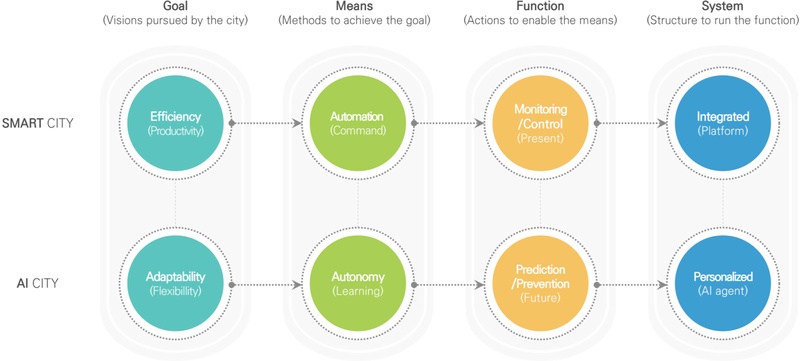
Research framework
1. Goal: Efficiency vs. Adaptability in Urban Management1)
Both concepts share the overarching goal of optimizing urban management, but they differ in how they pursue this objective. Traditional planning approaches usually aim for efficiency, that is, achieving predefined outcomes in order to cope with various urban uncertainties. By contrast, adaptive planning focuses less on specific contents or procedures and more on supporting the city’s capacity to respond to changing circumstances, thereby prioritizing adaptability (Rauws and De Roo, 2016). From this perspective, when comparing the two concepts, SC introduces advanced technologies as a means of enhancing efficiency in achieving urban goals, whereas AC emphasizes the use of technology as a tool for strengthening adaptability in the face of diverse situations arising within the management process.
SC, first of all, places emphasis on efficiency understood as optimally achieving various urban visions or goals (outcomes) with minimal cost and resources. To this end, SC provides ICT-based systematic solutions for the effective management of urban issues (Department for Business, Innovation and Skills, 2013). More recently, SC has evolved toward defining tailored visions that respond to each city’s specific challenges–such as the Resilient Smart City (RSC) and Inclusive Smart City (ISC)–and actively promoting ICT adoption as a key solution (de Oliveira Neto, 2018). In other words, SC seeks to recognize and leverage the numerous and diverse resources, services, and infrastructures dispersed across the city not as isolated entities but as interconnected components, thereby reducing losses in the urban management process and maximizing synergies.
In this regard, the SC approach can also be viewed as a process of transforming the urban system. Recent debates increasingly highlighted the benefits of converting traditional cities into SCs, such as maximizing urban productivity and fostering industrial regeneration (Ibrahim and Husein, 2025). Especially in small and medium-sized cities or shrinking cities with limited resources compared to large metropolitan areas, SC systems are perceived as opportunities for substituting labor, systematically managing idle spaces, and predicting and preventing disasters (Jang et al., 2024). In this context, SC focuses on keeping urban systems in a manageable state by minimizing operational errors through optimal mechanisms designed for urban management. While SC can maximize efficiency in a controllable environment and generate substantial benefits for tech-savvy groups with high levels of ICT access and digital literacy, it may simultaneously disadvantage information-disadvantaged groups (Jang and Gim, 2022).
By contrast, the goal of AC is to enhance the adaptability of urban systems so that they can conform and adjust to change in rapidly evolving urban environments. This approach involves AI processing data collected from the urban environment through algorithms and flexibly using the results for decisions on future urban operations, in ways that reflect the city’s spatial and social context (Yoon, 2025; Lee et al., 2023). In this vein, Lee et al. (2025) argued that the core function of AC is to enable cities, through Urban AI, to autonomously diagnose problems and make autonomous decisions for optimal urban operation. Consequently, AC places particular emphasis on the capacity to flexibly adjust urban goals and operational methods in response to errors or unexpected changes that arise during urban management.
Such adaptability can be realized through a cyclical system in which Urban AI continuously updates and improves itself via ongoing feedback and evaluation based on performance indicators (Lee et al., 2023). Furthermore, according to Wu (2025), AC must be capable of continuously adapting to the rapid advancement and iteration of science and technology. Therefore, AC needs to build a foundation that allows it to absorb new technologies continuously and rapidly, while at the same time selectively filtering and optimizing AI technologies so that they are integrated into society in line with actual demand. In other words, AC seeks to move beyond efficiency-oriented static systems toward an adaptive city model that anticipates future risks and needs in advance, reconfiguring its operation modes based on changes in city-wide conditions and in the circumstances of individual citizens.
2. Means: Automation vs. Autonomy2)
With respect to their means, both SC and AC use data-driven decision-making to achieve urban goals, but they implement this process in different ways. In both cases, AI supports decision-making through data interpretation and prediction; however, the forms of its application differ substantially. When distinguished by application type, SC primarily emphasizes augmentation (supporting human task performance) and automation (performing tasks autonomously under predefined, trained conditions), both of which correspond to weak AI, whereas AC focuses on autonomy (making direct judgments without human intervention), which corresponds to strong AI.3)
First, the fact that industrial automation constitutes the largest share of the global SC market–which has expanded from advanced economies to emerging ones, alongside the growing prominence of smart utilities (Kim and Lee, 2019)–demonstrates the central importance of automation within SC, particularly in industrial domains. Lim and Kim (2021) likewise noted that SC automation technologies, grounded in mathematical modeling and data-driven learning, are primarily oriented toward enhancing industrial and societal efficiency. SC operations broadly incorporate mechanisms that allow city systems to repeatedly and optimally execute rules or commands defined in advance by human managers. The use of algorithm-based big data has proven effective for coping with the complexity inherent to these mechanisms, which is often identified as a limitation of SC systems (Jang et al., 2024).
In SCs, such automation tools are used extensively, particularly in the areas of disaster prevention and energy management. For example, Seoul’s SC plan includes the development of a flood and stormwater disaster-response system designed to automate situation-specific responses across watershed units by using big data analytics (Seoul Metropolitan Government, 2021). South Korea’s first national smart city plan, the 1st Ubiquitous City Comprehensive Plan, similarly introduced projects such as web-based energy consumption control systems for households and automated control functions via smart appliances (Ministry of Land, Transport and Maritime Affairs, 2009). However, compared to the rapid advancement of automation technologies within SCs, a notable limitation is the insufficient development of supportive public policies–such as job creation programs and workforce development–to mitigate employment displacement and related challenges (Ban et al., 2017).
By contrast, AC operates on the basis of autonomy, in that the urban system does not follow predefined rules but instead interprets its environment and executes optimal decisions and adjustments through learning-based decision-making. Wu (2025) noted that AC requires an organizational model distinct from that of SC, in which multiple intelligent systems, rather than a single intelligent entity, are linked through communication-protocol mechanisms as an information infrastructure. These intelligent systems are organized in multiple layers, including functions that 1) make decisions on core urban issues, 2) handle subsystem domains such as transportation, 3) perform self-running decisions within localized spaces, and 4) initiate reflective decisions when abnormal data patterns are detected, with coordination among the layers achieved through the protocol mechanism.
Within AC, Urban AI serves as a stakeholder participating in urban governance (Cugurullo et al., 2024), supporting autonomous decision-making that is socially inclusive, fair, and trustworthy. Human-centered decision-making inherently struggles to remain value-neutral. Especially in urban environments where the ability to leverage advanced technologies directly shapes economic, social, and political opportunities, autonomy is therefore expected to play a crucial role in supporting more inclusive decision-making. Nonetheless, because citizen acceptance of AI-generated outputs is vital for governments to rationally use AI in public services, it is necessary to carefully consider citizens’ AI literacy and their willingness to adopt technology (Horvath et al., 2023). To this end, Urban AI ultimately aligns with the Autonomous City concept, seeking to secure autonomy by prioritizing infrastructure such as AI models and hyperscale data centers, as well as intelligent machines, including agents and robots (Lee et al., 2024).
3. Function: Monitoring/Control (Reactive) vs. Prediction/Prevention (Proactive)
Functionally, both SC and AC respond to urban problems as actions that implement their means, yet they differ in how these responses are operationalized. The OECD (2025a) identified the Predictive City as a future model of intelligent cities, arguing that AI can analyze data collected through sensors, digital twins, and administrative records to deliver not only reactive service provision but also predictive models that forecast risks, demand fluctuations, and system stress. Viewed in this light, the former, centered on real-time monitoring and control, corresponds to the primary functional orientation of SC, whereas the latter, focused on anticipatory prediction and prevention, characterizes the functional orientation of AC, highlighting a clear difference between the two.
In SCs, real-time monitoring is prioritized as a way to detect changes in the city’s current state and intervene reactively based on observed information. A representative example is the digital twin, a core technology for SC management that constructs 3D object models of real-world spatial environments and synchronizes them with virtual spaces for the purposes of monitoring and real-world control (Bibri and Huang, 2025). In South Korea, SC initiatives are also expanding efforts to integrate AI technologies in order to more efficiently utilize the large-scale urban datasets accumulated in data hubs. According to the most recent national plan–the 4th Comprehensive Smart City Plan–pilot projects are expected to be implemented to upgrade data hubs by incorporating AI-based tools that support urban planning and the monitoring of urban change (Ministry of Land, Infrastructure and Transport, 2024).
Particularly, in South Korea, SC technologies are being applied in the environmental and energy sectors–for example, intelligent grid-based energy control infrastructure and monitoring systems for real-time management of environmental pollution sources (Ministry of Land, Transport and Maritime Affairs, 2009). Also, major projects have been implemented in the safety and health sectors, including monitoring infrastructure to prevent accidents among vulnerable groups (Jang and Gim, 2023a) and smart healthcare systems such as health monitoring using smart bands (Seoul Metropolitan Government, 2021). Overall, SCs have primarily employed reactive interventions in daily-life service domains closely connected to citizens’ routines–detecting the city’s current state and making immediate adjustments, that is, real-time modulation of urban conditions based on observed facts.
In contrast, the functional core of AC lies in prediction- and prevention-oriented responses. This entails embedding capabilities that infer future risks and intervene proactively across the entire urban operation process. To this end, AC learns from past and present data to derive inferred probabilities, enabling operational modes that prevent potential problems from materializing (Wu, 2025). For instance, Lee et al. (2024) proposed a scenario of proactive urban problem-solving enabled by Urban AI, arguing that an AI-driven pipeline linking complaint classification, location identification, model-based prediction, and proactive action can reduce incident occurrence. Such predictive and preventive capabilities can substantially lower the likelihood of problems across various urban domains–including traffic congestion, environmental pollution, and disaster risks–thereby strengthening overall urban risk management.
Furthermore, by leveraging big data and computational power, AC can absorb large volumes of urban cases to extract developmental patterns within cities. This enables the classification of existing urban problems and the prediction of emerging challenges. Specifically, AC distinguishes among self-healing problems (current issues), new problems (future issues), and continuing problems (issues from the past), supporting the formulation of highly effective spatial and construction strategies at the municipal level (Wu, 2025). For example, South Korea’s ongoing Ultra-Large AI Common Infrastructure Project seeks to directly link large language model (LLM)–based predictive algorithms with urban data infrastructure to enable optimal decision-making (Lee et al., 2025). Building on such predictive decision-making systems, AC is expected to automate the entire lifecycle of urban operations.
4. System: Integrated vs. Personalized4)
From a system perspective, both concepts offer service configurations to support their respective functions, but they differ in how these configurations are organized. In intelligent city models, urban services can broadly be divided into two types. Integrated services bundle fragmented, department-based services from multiple sectors into a single account and provide one-stop, cross-sector delivery (OECD, 2025b), while personalized services enhance user satisfaction and participation by offering tailored services and opportunities to individual users (Quijano-Sanchez et al., 2020). In this context, SC primarily adopts the former, integrated service configuration, whereas AC is oriented toward the latter, personalized configuration.
In SCs, integrated services are provided by connecting individual datasets and services across the entire city in order to maximize interoperability. Building an integrated platform for this purpose has been a core policy in South Korean SC initiatives. Initially, demonstration services focused on crime prevention and disaster management, transportation, administration, and environment/energy, but have since expanded into domains such as culture, education, logistics, and housing (Seo et al., 2020). At the municipal level, integrated platforms are implemented either by expanding the functions of existing Urban Integrated Operation Centers (e.g., CCTV networks, intelligent traffic information systems) or by operating a separate Smart City Integrated Platform that is linked with the center to coordinate services (Jang and Gim, 2023b).
Notably, from a resource-circulation perspective, integrated platforms in SCs are used to manage, in an integrated manner, data from each stage of production and consumption, enabling an end-to-end understanding of resource flows within the city (Jang and Gim, 2023a). By linking previously fragmented existing data with newly collected data, these platforms are designed to enhance the efficiency of resource management systems. In addition, the Seoul Metropolitan Government’s Smart City and Digitization Master Plan calls for the establishment of an integrated disaster management system to strengthen climate resilience, providing disaster information services and decision-support functions across the prevention, response, and recovery phases (Seoul Metropolitan Government, 2021). Cloud computing, which serves as the operational infrastructure for these systems, underpins the SC integrated platform by enabling the centralized integration and management of service components–such as data, APIs, and analytical modules–and their flexible reallocation.
Meanwhile, AC systems are characterized by the provision of personalized services grounded in individual citizens, situations, and contexts, rather than by a universal service delivery model. According to Lee et al. (2024), existing related services–for example, those in SCs–have generated data and service models separately within each specialized domain. By contrast, Urban AI-based services are shifting toward a system in which city-scale AI, trained on local context and complexity, delivers customized public services tailored to individual needs and life-cycle stages. This indicates that the system unit for optimizing urban operations is narrowing from the city scale to the level of individuals and their specific circumstances (i.e., contexts). Among next-generation AI technologies, emotional intelligence is expected to foreground the emotional dimension of urban life by enabling AI to recognize citizens’ emotions and provide more personalized services through dedicated feedback mechanisms (Wu, 2025).
Ultimately, personalized systems in AC aim not only to customize services, but also to bring about structural changes in which autonomous AI learns citizens’ contexts–for example, behavioral patterns, locations, and preferences–and reconfigures and adjusts urban services themselves. Finland’s Aurora AI initiative, for instance, provides personalized administrative services through an AI assistant that responds to life-cycle events such as changes in family composition, expanded employment opportunities, or relocation (National Information Society Agency, 2022). To this end, it operates a digital platform that uses reinforcement learning and long-term data to identify which services are most needed by particular user groups and to prioritize their delivery. However, AI-based personalized services require the extraction of larger volumes of personal information and more extensive monitoring of private activities than universal services (Cugurullo et al., 2024). Accordingly, in AC, a key challenge is to establish governance frameworks that ensure algorithmic transparency and accountability in order to uphold data ethics and protect privacy.
Ⅳ. Synthesis and Recommendations
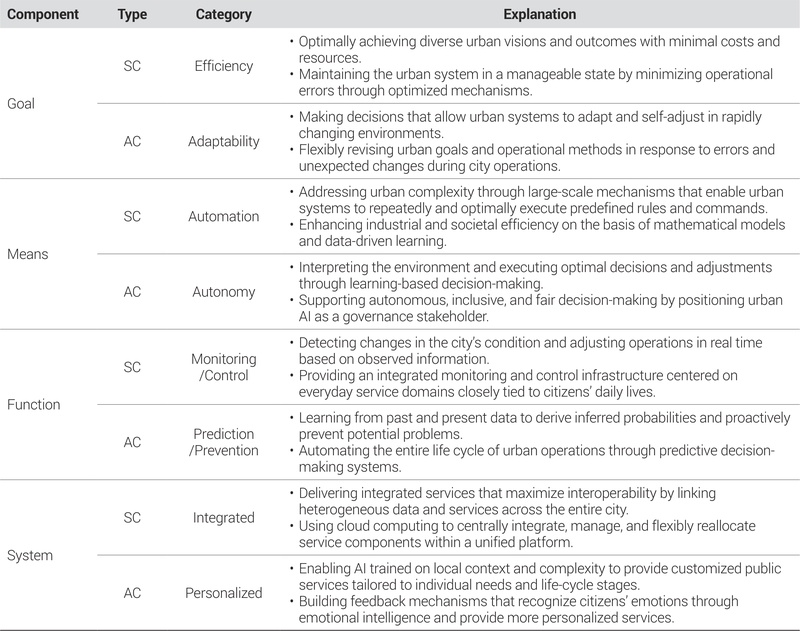
<Table 1> summarizes the analytical results presented in Chapter III. The AC pursues adaptability in urban management and identifies autonomy as the core means for achieving this goal. The analysis further shows that prediction and prevention constitute the primary functions through which autonomy is operationalized in AC, and that a personalized service–oriented system serves as the foundational infrastructure enabling these functions.

Summary of the characteristics of SC and AC concepts
Compared to Nam and Pardo (2011), who conceptualized SC components around major domains constituting cities–namely technology, people, and institutions–this study adopts a different focus by shifting attention from domains themselves to the roles they actually perform. Accordingly, it characterized AC from a functional perspective encompassing methods (i.e., means), actions (function), and structure (system).
Furthermore, in comparison with Jang (2025)’s study, which proposed a framework for AC transition consisting of autonomy (technology), adaptability (system), and co-evolution (paradigm), this study shows that the higher-level components (goal and means) were framed within a similar context. However, the lower-level components (function and system) exhibited characteristics that differ from those of SC, such as personalization.
AI technologies have already played a central role in SC policies and plans, so AC can be viewed as part of the SC’s developmental trajectory rather than as an entirely new urban model. However, the analysis reveals that AC may exhibit characteristics that distinguish it from, and in some respects even contrast with, those of SC. Most notably, the AC’s goal–making decisions that flexibly adapt to changing urban conditions based on learning and prediction–stands in clear contrast to the SC’s focus on efficiently executing input commands according to predefined mechanisms. Moreover, whereas the SC has operated under the City-as-a-Platform discourse–anchored in the integrated management of diverse data, services, and infrastructure, as well as collaboration among stakeholders–the AC is expected to shift toward a City-as-an-Agent5) discourse. Under this perspective, the entire city, understood as the aggregate of individual units such as humans or AI agents, is anticipated to act as the primary decision-making entity.
Synthesizing these findings, proposals for implementing AC in South Korea can be organized around four dimensions: spatial hierarchy, application targets, SC resources, and governance and ethics. First, AC in South Korea should be developed on top of the national infrastructure of the Digital Platform Government, in a form where each spatial level–nation, region, and city–possesses autonomous intelligence and collaborates with the others. At the national level (i.e., AI nation), policy should move beyond fragmented, municipality-specific data dams toward a shared hyperscale AI model trained on South Korea’s administrative, legal, and cultural context, so that all cities can provide intelligent administrative services at a standardized level. At the regional level (AI region), AI could simulate in advance the spillover effects that changes in one city may have on neighboring cities by linking data across administrative boundaries and deploying metropolitan digital twins, mediating conflicts and synchronizing operations. At the city level (AC), existing passive control centers can be transformed into autonomous operation centers, where AI learns from the full range of sensor data within the city and uses this learning to predict and prevent traffic congestion, crime, and disaster signals, establishing a proactive operational system.
Second, as in SC, application targets were categorized into new cities, existing cities, and declining cities; however, AC requires strategies that prioritize adaptability and personalized services tailored to the characteristics of each locality rather than uniform solutions. For the 3rd Generation New Towns currently under development, AI data centers capable of operating LLMs and processing urban data could be integrated from the urban design stage, and robot-friendly infrastructure can be linked as an essential component so that autonomous systems can actually interact with and control physical spaces. By contrast, existing cities such as Seoul, where physical expansion measures like road widening have reached their limits, need to adopt adaptive strategies. In these cases, existing digital twins (e.g., S-Map) should evolve into intelligent simulation environments in which AI can learn, with optimal signal-operation parameters validated in the virtual environment and subsequently applied to the real world to minimize effort and investment. Specifically, for small and medium-sized cities in non-metropolitan areas that are experiencing rapid aging and population outflow, it is essential to establish an AI safety net centered on personalized services. Such a safety net can substitute for limited public personnel and fill gaps in care for older adults living alone by providing individualized support for their health and daily lives.
Third, South Korea’s existing SC resources–SC master plans and dedicated SC departments in local governments–need to evolve beyond their current focus on infrastructure construction and management and be strengthened to function as AI control towers that anticipate and prevent urban problems. Concretely, future SC plans, such as the 5th Comprehensive Smart City Plan, could be restructured into AI City Comprehensive Plans centered on the prediction and simulation of future risks, with responsible organizations cultivating the expertise needed to direct data-driven, proactive responses. Also, the current Smart City Certification System administered by the Ministry of Land, Infrastructure and Transport could be reoriented from focusing on post-incident management to evaluating a city’s capacity for proactive problem-solving, incorporating quantitative predictive metrics (e.g., accident prevention rates) as core indicators. In South Korea, the SC development trajectory appears to be evolving from SC toward AI-enabled SC, and further toward AC, suggesting that a phased approach to implementation will be required in the medium to long term.
Finally, it is essential to establish an AI governance framework that aligns with South Korea’s strict standards for personal information protection and algorithmic fairness. To deliver sophisticated personalized services without centrally aggregating sensitive biometric or location data, a distributed system based on federated learning can be adopted, in which data are processed on users’ devices (on-device) and only learned model weights are shared. In addition, to resolve the opacity that may arise in decision-making processes under AI-driven autonomous control, the application of Explainable AI (XAI) can be made mandatory. This would ensure that the grounds and procedures underlying decisions in AC are presented in ways that are understandable to humans, securing transparency and accountability in urban decision-making.
Ⅴ. Conclusions
With the adoption of the K-AI City initiative as a national policy priority by the new administration, interest has grown in exploring ways to deploy AI technologies across the entire urban space. At the same time, however, debate has intensified over whether AC should be understood as a subsequent developmental stage of the existing SC or as a new future-oriented urban model. To address this debate, it is necessary to first establish the fundamental components that constitute the AC concept and, based on this conceptual foundation, to discuss appropriate pathways for constructing AC models. Hence, this study compared the components of the AC and SC concepts–namely goals, means, functions, and systems–to identify their distinguishing characteristics through a literature review.
The analysis demonstrated that although AC can be understood as part of the SC’s developmental trajectory, it nevertheless exhibited characteristics that differ from those of SC. SC pursues efficiency in urban management and centers on automation as its core means. Monitoring and control were identified as the key functions that operationalize automation in SC, and a system that provides integrated services constitutes the foundational infrastructure enabling these functions. Conversely, AC seeks adaptive urban management, with autonomy as its primary means. Prediction and prevention were identified as the core functions through which autonomy is enacted, supported by a personalized service system that provides the basis for their implementation.
Synthesizing these findings, this study argued that SC has been grounded in the City-as-a-Platform discourse, emphasizing integrated management of data, services, and infrastructure and stakeholder collaboration. By contrast, AC is likely to shift toward a City-as-an-Agent discourse, in which the city, understood as the collective sum of individual units (persons or AI agents), functions as an autonomous decision-making entity.
Based on these results, this study presented recommendations for implementing AC in South Korea across four dimensions: spatial hierarchy, application targets, SC resources, and governance and ethics. First, AC in South Korea should be developed on top of the national infrastructure of the Digital Platform Government, in a form where each spatial level–nation, region, and city–possesses autonomous intelligence and collaborates with the others. Second, as in SC, application targets were categorized into new cities, existing cities, and declining cities; however, AC requires strategies that prioritize adaptability and personalized services tailored to the characteristics of each locality rather than uniform solutions. Third, South Korea’s existing SC resources–SC master plans and dedicated SC departments in local governments–need to evolve beyond their current focus on infrastructure construction and management and be strengthened to function as AI control towers that anticipate and prevent urban problems. Finally, it is essential to establish an AI governance framework that aligns with South Korea’s strict standards for personal information protection and algorithmic fairness.
This study has several limitations. First, the AC components derived from the analysis could be examined more closely against official documents–such as policy papers and planning reports–to clarify in what ways and in which contexts they are reflected in actual policies, plans, and projects. Accordingly, a case-based examination is required to link the conceptual discussions derived from this study to their implications for actual planning practice. Second, empirical analyses, for example through expert interviews, are needed to verify the validity of the analytical results and to derive policy priorities for AC implementation strategies across different time horizons (short-, medium-, and long-term). Third, while this study provides an account of the characteristics of SC and AC, it remains limited in interpreting the relationships among these characteristics. Hence, future research is needed to empirically examine how the characteristics of these two urban models differ in practice. Fourth, future research can conduct comparative case studies of countries at the forefront of AC policy–including the United States, China, Singapore, and South Korea–to examine differences in their geographical, policy, and social contexts and to identify how their governance structures for AC implementation diverge. In particular, through case examples in sectors such as mobility management, infrastructure maintenance, or emergency response, a more systematic comparison with the approaches adopted in SCs can be provided. Finally, further study is needed to refine the conceptual lens for a more rigorous comparison of the two urban models, such as from the theoretical perspectives of algorithmic governance, socio-technical systems, and planning epistemologies.
References
- Ban, Y.U., Kim, Y.M., Hong, N.E., Han, K.M., and Baek, J.I., 2017. “Implementation Measures for Sustainable Smart City”, Journal of the Korean Regional Science Association, 33(1): 45-57.
-
Berntzen, L. and Johannessen, M.R., 2015. “The Role of Citizen Participation in Municipal Smart City Projects: Lessons Learned from Norway”, In Smarter as the New Urban Agenda: A Comprehensive View of the 21st Century City, edited by Gil-Garcia, J., Pardo, T., and Nam, T., 299-314, Cham: Springer International Publishing.
[https://doi.org/10.1007/978-3-319-17620-8_16]

-
Bibri, S.E. and Huang, J., 2025. “Artificial Intelligence of Things for Sustainable Smart City Brain and Digital Twin Systems: Environmental Synergies between Real-Time Management and Predictive Planning”, Environmental Science and Ecotechnology, 26: 100591.
[https://doi.org/10.1016/j.ese.2025.100591]
-
Cugurullo, F., Caprotti, F., Cook, M., Karvonen, A., McGuirk, P., and Marvin, S., 2024. “The Rise of AI Urbanism in Post-smart Cities: A Critical Commentary on Urban Artificial Intelligence”, Urban Studies, 61(6): 1168-1182.
[https://doi.org/10.1177/00420980231203386]
-
Das, P., Woods, O., and Kong, L., 2025. “Right‐sizing the Smart City in Southeast Asia”, Area, 57(3): e70014.
[https://doi.org/10.1111/area.70014]
- Department for Business, Innovation and Skills, 2013. Smart Cities: Background Paper, The Government of the United Kingdom.
- de Oliveira Neto, J.S., 2018. “Inclusive Smart Cities: Theory and Tools to Improve the Experience of People with Disabilities in Urban Spaces”, Ph.D. Dissertation, Universite Paris Saclay (COmUE); Universidade de Sao Paulo (Brasil).
- Giffinger, R., Fertner, C., Kramar, H., Kalasek, R., Pichler-Milanovic, N., and Meijers, E.J., 2007. Smart Cities –Ranking of European Medium-sized Cities, Vienna, UT: Centre of Regional Science.
-
Horvath, L., James, O., Banducci, S., and Beduschi, A., 2023. “Citizens’ Acceptance of Artificial Intelligence in Public Services: Evidence from a Conjoint Experiment about Processing Permit Applications”, Government Information Quarterly, 40(4): 101876.
[https://doi.org/10.1016/j.giq.2023.101876]
-
Ibrahim, A.F. and Husein, H.A., 2025. “Building an Analytical Human-Centered Conceptual Framework Model for Integrating Smart Technology to Retrofit Traditional Cities into Smart Cities”, Buildings, 15(19): 3597.
[https://doi.org/10.3390/buildings15193597]
-
Jang, S.G.D., 2025. “A Conceptual Framework for AI City Transition: Technology, Systems, and Paradigms”, Journal of The Korean Urban Management Association, 38(4): 79-95.
[https://doi.org/10.36700/KRUMA.2025.12.38.4.79]
-
Jang, S.G.D., Bayarsaikhan, T., and Gim, T.H.T., 2024. “An Alternative Discourse on the Shrinking City: Through the Lens of the Smart City”, Journal of Korea Planning Association, 59(1): 60-72.
[https://doi.org/10.17208/jkpa.2024.02.59.1.60]
-
Jang, S.G. and Gim, T.H.T., 2022. “Considerations for Encouraging Citizen Participation by Information-Disadvantaged Groups in Smart Cities”, Sustainable Cities and Society, 76: 103437.
[https://doi.org/10.1016/j.scs.2021.103437]
- Jang, S.G.D. and Gim, T.H.T., 2023a. “Sustainability Elements of the Sustainable Smart City”, Journal of The Korean Regional Development Association, 35(5): 1-25.
-
Jang, S.G.D. and Gim, T.H.T., 2023b. “Smart City Planning Elements: Analyzing the Consistency between the National Comprehensive Plan and Municipality-Level Plans in Certified Cities”, Journal of The Korean Urban Management Association, 36(3): 123-145.
[https://doi.org/10.36700/KRUMA.2023.9.36.3.123]
-
Jang, S.G.D. and Lee, J.H., 2025. “Changes in Smart City Components by Developmental Stage”, Journal of Korea Planning Association, 60(5): 5-20.
[https://doi.org/10.17208/jkpa.2025.10.60.5.5]
- Kim, S. and Lee, Y., 2019. “Policy and Legislative Studies on Smart City Construction”, Law Review, 19(4): 163-202.
-
Komninos, N., Kakderi, C., Panori, A., and Tsarchopoulos, P., 2019. “Smart City Planning from an Evolutionary Perspective”, Journal of Urban Technology, 26(2): 3-20.
[https://doi.org/10.1080/10630732.2018.1485368]
-
Lee, S.H. and Leem, Y.T., 2014. “U-City Oversea Expansion Strategy through Comparison of U-City with Smart City”, Journal of Korea Planning Association, 49(4): 243-252.
[https://doi.org/10.17208/jkpa.2014.07.49.4.243]
-
Lee, S.H. and Leem, Y.T., 2016. “Analyzing Characteristics of the Smart City Governance”, Journal of the Korean Association of Geographic Information Studies, 19(2): 86-97.
[https://doi.org/10.11108/kagis.2016.19.2.086]
- Lee, S.W., Yu, J.S., Lee, K.H., and Jeong, Y.J., 2023. A Study on Policy Measures for the Implementation of Urban AI, Sejong: Korea Research Institute for Human Settlements.
- Lee, S.W., Yu, J.S., Lim, S.Y., Kim, D.J., Yu, I.J., and Park, D.G., 2024. Urban AI-Based Prediction and Response to Urban Issues: Focusing on Complaint Data, Sejong: Korea Research Institute for Human Settlements.
- Lee, S.W., Lim, S.Y., Lee, B.J., Jang, Y.H., Jeong, Y.J., and Min, H.K., 2025. “Policy Directions and Tasks for Implementing the K-AI City”, Urban Information Service, 523: 5-16.
- Lim, C.H. and Kim, K.J., 2021. “An Integrated Understanding of the Smart City: Collaboration Between Machines and Humans”, Civilization & Frontier, 4: 219-255.
- Ministry of Land, Transport and Maritime Affairs, 2009. 1st Ubiquitous City Comprehensive Plan (2009~2013), Gwacheon City.
- Ministry of Land, Infrastructure and Transport, 2019. 3rd Smart City Comprehensive Plan(2019~2023), Sejong.
- Ministry of Land, Infrastructure and Transport, 2024. 4th Smart City Comprehensive Plan (2024~2028), Sejong.
-
Nakamura, M. and Du Bousquet, L., 2015. “Constructing Execution and Life-cycle Models for Smart City Services with Self-aware IoT”, Paper presented at the 2015 IEEE International Conference on Autonomic Computing, 289-294, Grenoble, France.
[https://doi.org/10.1109/ICAC.2015.57]
-
Nam, T. and Pardo, T.A., 2011. “Conceptualizing Smart City with Dimensions of Technology, People, and Institutions”, In Proceedings of the 12th Annual International Digital Government Research Conference: Digital Government Innovation in Challenging Times, 282-291.
[https://doi.org/10.1145/2037556.2037602]
- National Information Society Agency, 2022. Finland’s Human-Centered Digital Platform Government: The AuroraAI Program, Daegu.
- OECD, 2025a. “Artificial Intelligence for Advancing Smart Cities”, Paper presented at the 5th OECD Roundtable on Smart Cities and Inclusive Growth, OECD Headquarters: Paris.
- OECD, 2025b. Digital Government Review of Korea: Harnessing Digital and Data to Transform Government, OECD Digital Government Studies, Paris: OECD Publishing.
-
Palmini, O. and Cugurullo, F., 2023. “Charting AI Urbanism: Conceptual Sources And Spatial Implications Of Urban Artificial Intelligence”, Discover Artificial Intelligence, 3(5).
[https://doi.org/10.1007/s44163-023-00060-w]
- Popelka, S., Zertuche, L., and Beroche, H., 2023. Urban AI Guide, Paris, France: Urban AI.
- Presidential Committee on Policy Planning, 2025. Five-Year National Administration Plan of the Lee Jae-myung Government, Seoul.
-
Quijano-Sanchez, L., Cantador, I., Cortes-Cediel, M.E., and Gil, O., 2020. “Recommender Systems for Smart Cities”, Information Systems, 92: 101545.
[https://doi.org/10.1016/j.is.2020.101545]
-
Rauws, W. and De Roo, G., 2016. “Adaptive Planning: Generating Conditions for Urban Adaptability. Lessons From Dutch Organic Development Strategies”, Environment and Planning B: Planning and Design, 43(6): 1052-1074.
[https://doi.org/10.1177/0265813516658886]
-
Seo, C.S., Kim, Y.T., and Kim, S.H., 2020. “A Study on the Big Data Priority for Activating Sustainable Smart City Service”, Journal of The Korean Urban Management Association, 33(4): 57-79.
[https://doi.org/10.36700/KRUMA.2020.12.33.4.57]
- Seo, H. and Myeong, S., 2023. “Institutional Isomorphism of Local Smart City Policy: Focusing on Contents Analysis of Local Smart City Policy Plan”, Journal of Korean Association for Regional Information Society, 26(4): 171-209.
- Seoul Metropolitan Government, 2021. Smart City and Digitization Master Plan (2021~2025), Seoul.
-
Sharifi, A., 2019. “A Critical Review of Selected Smart City Assessment Tools and Indicator Sets”, Journal of Cleaner Production, 233: 1269-1283.
[https://doi.org/10.1016/j.jclepro.2019.06.172]
-
Shao, J. and Min, B., 2025. “Sustainable Development Strategies for Smart Cities: Review and Development Framework”, Cities, 158: 105663.
[https://doi.org/10.1016/j.cities.2024.105663]
-
Sta, H.B., 2017. “Quality and the Efficiency of Data in “Smart-Cities”, Future Generation Computer Systems, 74: 409-416.
[https://doi.org/10.1016/j.future.2016.12.021]
-
Svítek, M., Skobelev, P., and Kozhevnikov, S., 2019. “Smart City 5.0 as an Urban Ecosystem of Smart services”, In Service Oriented, Holonic and Multi-agent Manufacturing Systems for Industry of the Future. SOHOMA 2019. Studies in Computational Intelligence, vol 853, edited by Borangiu, T., Trentesaux, D., Leitão, P., Giret Boggino, A., and Botti, V., 426-438, Cham: Springer International Publishing.
[https://doi.org/10.1007/978-3-030-27477-1_33]
-
Svitek, M., Kozhevnikov, S., Tencar, J., Bhattacharjee, S., and Benes, V., 2023. “Smart City 5.0 as the Digital Ecosystem of Smart Services: Practical Applications”, In Smart Cities and Digital Transformation: Empowering Communities, Limitless Innovation, Sustainable Development and the Next Generation, edited by Lytras, M.D., Housawi, A.A., and Alsaywid, B.S., 327-354, Emerald Publishing Limited.
[https://doi.org/10.1108/978-1-80455-994-920231016]
-
Vanolo, A., 2014. “Smartmentality: The Smart City as Disciplinary Strategy”, Urban Studies, 51(5): 883-898.
[https://doi.org/10.1177/0042098013494427]
-
Wu, S.Z., 2025. “The Opportunities and Challenges of Constructing AI Cities in China”, In The AI City. The Urban Book Series, 231-236, Singapore: Springer.
[https://doi.org/10.1007/978-981-96-2560-4_14]
- Yoon, J.B., 2025. “AI City: A New Urban Future Shaped by Artificial Intelligence”, Urban Information Service, 523: 3-4.
-
Yuan, D. and Hwang, J., 2025. “Can Smart City Development Alleviate Urban Shrinkage in the Traditional Urban Development Process?”, Cities, 160: 105847.
[https://doi.org/10.1016/j.cities.2025.105847]
-
Yun, Y. and Lee, M., 2019. “Smart City 4.0 from the Perspective of Open Innovation”, Journal of Open Innovation: Technology, Market, and Complexity, 5(4): 92.
[https://doi.org/10.3390/joitmc5040092]
- Zafar, S., 2024. “Smart Cities: The Role of AI in Urban Planning and Sustainable Development”, Journal of AI Range, 1(1): 27-39.
-
Zhang, L., Hou, Y., Deng, K., and Xin, J., 2025. “Advancements Toward a Standard System for Intelligent Operation and Maintenance of Buildings and Municipal Facilities”, Buildings, 15(21): 3965.
[https://doi.org/10.3390/buildings15213965]
-
Zwick, A. and Spicer, Z., 2024. “Examining the Smart City Generational Model: Conceptualizations, Implementations, and Infrastructure Canada’s Smart City Challenge”, Urban Affairs Review, 60(4): 1229-1253.
[https://doi.org/10.1177/10780874231222243]
- Cohen, B., 2015, Aug. 10. “The 3 Generations Of Smart Cities”, Fastcompany Impact, https://www.fastcompany.com/3047795/the-3-generations-of-smart-cities