Interaction Effects of Intersection Safety Countermeasures: Evidence from 1,892 Accident-Prone Intersections Nationwide
 ; Kwon, Kyusang***
; Heo, Taeyoung****
; Song, Tai-Jin*****
; Kwon, Kyusang***
; Heo, Taeyoung****
; Song, Tai-Jin*****
Abstract
This study analyzed the effects of the combined implementation of traffic safety countermeasures in Korea to reduce accidents. While most existing studies have focused on single countermeasures, multiple measures are often applied together in practice. However, studies on their interaction effects remain limited. This study examined cases of combined implementation across accident-prone intersections, statistically assessing both main and interaction effects on accident frequency and severity. The results showed that certain combinations of countermeasures were more effective than single installations, contributing not only to accident reduction but also to mitigating accident severity. These findings underscore the importance of a strategic approach to traffic safety policies that considers the combined application of countermeasures, thereby helping reduce the social costs of traffic accidents.
Keywords:
Intersection Safety, Traffic Safety Countermeasures, Traffic Safety Facilities, Combined Implementation, Interaction Effect키워드:
교차로 안전, 교통안전 개선대책, 교통안전시설, 병행 설치, 상호작용 효과Ⅰ. Introduction
Thanks to national efforts, the number of road traffic accident deaths in Korea has sharply decreased from 10,236 in 2000 to an all-time low of 2,521 in 2024. However, the rate of decrease in the accident frequency has not kept pace with this decline (Figure 1). According to 2022 international statistics, the number of traffic accident deaths per 100,000 people in Korea reached 5.3, which was 0.98 times the OECD average of 5.4. On the other hand, the accident frequency per 100,000 people stood at 381.3, 1.58 times the OECD average of 242.0, remaining in the worst positions in the list over a substantial period. Therefore, effective measures to reduce accidents are urgently needed.
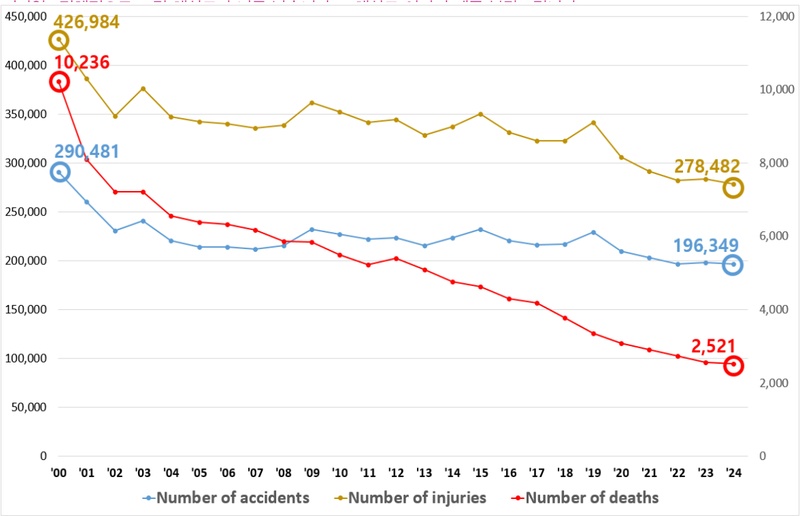
Trends in road traffic accidents in Korea
Reducing traffic accidents requires addressing three key factors: human, road environment, and vehicle factors (AASHTO, 2010). Among these, addressing road environmental deficiencies requires measures such as installing and maintaining appropriate safety facilities and improving road structures. South Korea invests approximately 1.7 trillion KRW annually into facility improvements to prevent and reduce traffic accidents (Ministry of Land, Infrastructure and Transport, 2024).
To enhance the efficiency of this massive traffic safety budget, it is crucial to quantify the effectiveness of the various traffic safety countermeasures implemented on-site. Accordingly, many researchers have conducted studies on delineation devices (Park et al., 2006; Yoon, 2016), road lighting (Hovey and Chowdhury, 2005; Yang et al., 2019), skid-resistant pavement (Lee et al., 2011; Von Quintus and Mergenmeier, 2015), and automated enforcement equipment (Goldenbeld et al., 2019; Cohn et al., 2020). Recently, effectiveness analyses have also been conducted on traffic islands (Ki and Kim, 2023), crosswalks (Maeng, 2024), and colored road guidance lines (Lim and Han, 2024).
However, previous studies have primarily focused on the accident reduction effects of single traffic safety countermeasures. However, in most traffic safety projects implemented in Korea (e.g., improvement projects for accident-prone areas, improvement projects for child and elderly protection zones, and improvement projects for pedestrian environments), improvement measures are rarely implemented alone; rather, they are often applied in combination. Furthermore, Al-Marafi et al. (2024) and Zhang et al.(2023) argued that the combined application of traffic safety countermeasures and analysis of their effectiveness are necessary for substantial accident reduction. Therefore, quantitatively analyzing the effects of combining various traffic safety countermeasures is a crucial theoretical and practical task, yet research on this topic remains insufficient.
Furthermore, previous studies have primarily focused on reducing accident frequency as well as underscoring the importance of accident severity in improving traffic safety (Hauer, 1997; AASHTO, 2010; Vingilis, 2016; Byaruhang and Evdorides, 2022). Reducing accident severity directly leads to a reduction in the social costs of traffic accidents (Korea Road Traffic Authority, 2024a).
Responding to this need, this study was performed by collecting data on the implementation scale of traffic safety countermeasures and accident data from the improvement projects for accident-prone areas, which are the longest-running traffic safety improvement projects in Korea. Through this, the main effects and interaction effects of the combined implementation of traffic safety countermeasures were analyzed in terms of accident frequency and the severity of accidents. Based on this analysis, this study aims to derive effective traffic safety improvement strategies.
Ⅱ. Theoretical Background
1. Traffic Safety Countermeasures and Effect Analysis Method
In the field of traffic safety, the term “countermeasure” refers to traffic safety programs or approaches aimed at reducing specific types of accidents and may be used interchangeably with treatment or intervention. Some studies focus on traffic calming to reduce vehicle traffic volume and speeds or infrastructure-centered countermeasures such as installing physical facilities and regulating traffic flow to provide a safe and pleasant road environment for pedestrians (Ministry of Land, Infrastructure and Transport, 2019). Some studies focus on infrastructure-based measures, such as traffic calming1) or roundabouts, while others emphasize behavioral measures, such as enforcement and traffic safety campaigns. This study describes countermeasures applied in road environment improvement projects, which focus on infrastructure.
Road environment improvement projects refer to projects implementing various countermeasures for improving the physical and operational environment of roads to reduce traffic accidents and enhance the safety of road users (Han et al., 2004). These projects encompass various countermeasures, including road design modifications, safety facility expansion, and traffic operation efficiency enhancement, including signal system adjustments. Currently, the safety facility expansion is the most active project in Korea. This study focuses on 13 traffic safety countermeasures, focusing on traffic safety facilities stipulated in the Road Traffic Act and the road safety facilities stipulated in the Rules on the Road Structure & Facilities Standards.2)
There are various methods for estimating the accident reduction effect of traffic safety countermeasures, but traditionally, they are broadly classified into cross-sectional analysis and before-and-after study (Hauer, 1997; Persaud, 2001; Shen and Gan, 2003).
Cross-sectional analysis is a method for analyzing the effectiveness of countermeasures using data collected from multiple locations (e.g., regions, road sections, intersections) at a specific point in time. This method is useful when the precise implementation timing of countermeasures is unknown or data is insufficient (Kwak, 2020). Regression-based statistical methods, such as general linear regression, Poisson regression, and logistic regression, are frequently employed. Cross-sectional analysis offers the advantages of being fast and simple, allowing for simultaneous evaluation of multiple locations. However, cross-sectional analysis has limitations that the method cannot reflect temporal changes and environmental factors are difficult to control, which may lead to interpretations of correlations rather than causality.
Due to these limitations, before-and-after studies have been primarily utilized in recent years. This method allows for a more direct impact analysis than cross-sectional analysis, as accident data before and after the implementation of countermeasures are compared to assess the actual accident reduction effect. A before-and-after study includes simple before-and-after evaluation, before-and-after evaluation with a comparison group, and empirical Bayes evaluation (Shen and Gan, 2003).
First, the simple before-and-after evaluation, which compares the results before and after the application of countermeasures at the same location, is widely used due to its simple calculation process. However, it has the disadvantage of not considering the impacts of other factors, which may lead to distorted results. The simple before-and-after evaluation involves the calculation shown in Equation (1).
| (1) |
Second, the before-and-after evaluation with a comparison group, which analyzes multiple sites, was proposed by Hauer to account for the impacts of factors that are difficult to measure through field surveys, such as weather, socioeconomic factors, and driver characteristics. This method involves the calculation shown in Equation (2) (Lee et al., 2007).
| (2) |
Third, the empirical Bayes evaluation is based on the logic of correcting the uncertainty in the prior distribution with the posterior distribution. For already implemented countermeasures, the accident frequency expected by assuming non-implementation is derived using a Bayesian relation and compared with the actual accident frequency. This is calculated as shown in Equation (3) (Kwon et al., 2012; Lim et al., 2016).
| (3) |
2. Literature Review
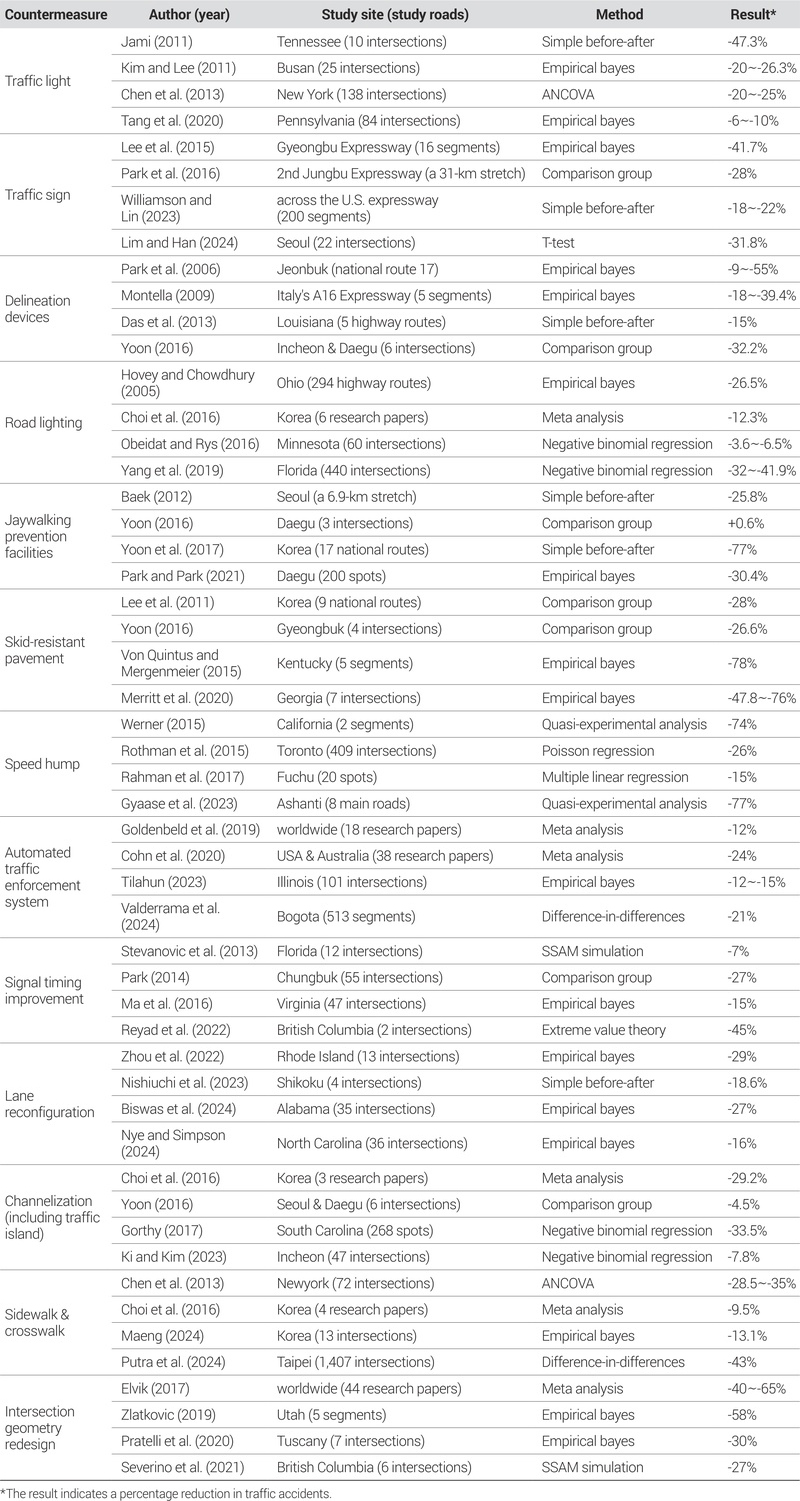
There are many previous studies analyzing the effectiveness of countermeasures, most of which have examined the reduction in accidents following the implementation of traffic safety countermeasures. <Table 1> summarizes previous studies on each of the 13 traffic safety countermeasures covered in this study, with four studies summarized for each countermeasure.

Summary of related studies on the effectiveness of traffic safety countermeasures
Installing traffic lights has been reported to reduce accidents by 6% to 47% (Jami, 2011; see <Table 1>). Installing traffic sign reduced accidents by 18% to 42% (Lee et al., 2015; see <Table 1>). Installing delineation devices reduced accidents by 9% to 55% (Park et al., 2006; see <Table 1>). Installing road lighting reduced accidents by 4% to 42% (Hovey and Chowdhury, 2005; see <Table 1>). Installing jaywalking prevention facilities reduced accidents by -1% (1% increase) to 77% (Baek, 2012; see <Table 1>). Skid-resistant pavement reduced accidents by 27% to 78% (Lee et al., 2011; see <Table 1>). Installing speed hump reduced accidents by 15% to 77% (Werner, 2015; see <Table 1>). Installing automated traffic enforcement system reduced accidents by 12% to 24% (Goldenbeld et al., 2019; see <Table 1>).
In addition, signal timing improvement has been reported to reduce accidents by 7% to 45% (Stevanovic et al., 2013; see <Table 1>). Lane reconfiguration reduced accidents by 16% to 29% (Zhou et al., 2022; see <Table 1>). Channelization reduced accidents by 5% to 34% (Choi et al., 2016; see <Table 1>). Installing sidewalk & crosswalk reduced accidents by 10% to 43% (Chen et al., 2013; see <Table 1>). Intersection geometry redesign reduced accidents by 27% to 65% (Elvik, 2017; see <Table 1>).
The review of previous studies analyzing the effectiveness of traffic safety countermeasures provided the following three implications.
First, previous studies focused on the effectiveness of single countermeasures, resulting in discrepancies across researchers, even for the same countermeasures. This discrepancy stems from limitations in the data collection process, such as inconsistencies in the target areas and road types, difficulties in establishing a comparison group, and small sample sizes. For example, the accident reduction effects of jaywalking prevention facilities ranged from -1% to 77%, while those of speed humps ranged from 15% to 77%, showing significant variation.
Second, while research has focused on specific types of countermeasures, such as speed humps and signal timing improvement, analysis of various countermeasures frequently applied on sites in Korea remains insufficient. Most studies on intersection geometry redesign have been limited to roundabouts.
Third, previous research has primarily focused on accident frequency, with relatively little consideration given to accident severity. However, given that a significant portion of the social costs of traffic accidents results from human casualties, accident severity is a crucial indicator, just as important as accident frequency. Hauer (1997) and AASHTO (2010) also emphasize the need to consider both factors.
Based on these implications, the present study offers the following distinct advantages. First, by leveraging data from the government's “Traffic Accident-Prone Area Improvement Project,” a large and sophisticated dataset was set, ensuring analytical reliability. Second, 13 countermeasures, including those not adequately addressed in previous studies conducted in Korea, were compared under identical conditions to analyze the main effects and the interaction effects of combined implementation. Third, by quantifying accident severity based on cost data, a more practical ground for policy decision-making was provided.
III. Analytical Method
1. Selection of Analysis Targets
In this study, analysis targets were selected to precisely compare the effects and interactions of traffic safety countermeasures.
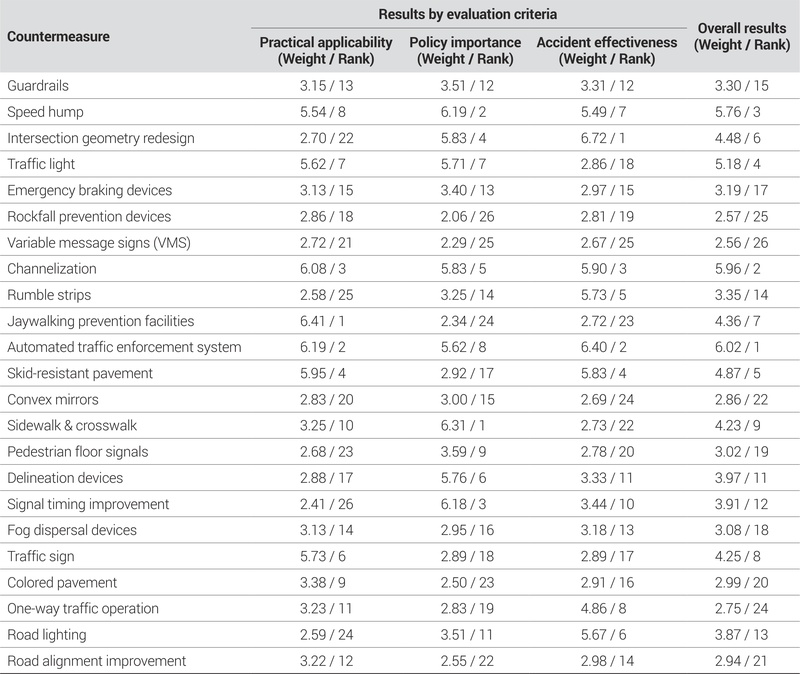
To this end, an expert survey was conducted targeting practitioners performing technical support tasks (7,106 cases in 2023) at the Korea Road Traffic Authority. Key countermeasures repeatedly found in technical support reports were derived as a primary candidate group (26 items) and then evaluated by 50 practitioners having at least five years of work experience.
Three evaluation criteria were set: practical applicability, policy significance, and accident reduction effectiveness. Practical applicability refers to the feasibility and ease of on-site implementation, policy significance refers to the relevance to national traffic safety policy goals, and accident reduction effectiveness refers to the contribution to reducing traffic accidents.
The relative importance of each criterion was assessed using the Analytic Hierarchy Process (AHP), and the priorities of candidate countermeasures were derived using the Best–Worst Method (BWM). AHP has strengths in estimating weights of the criteria, while BWM has strengths in ensuring consistency and efficiency in comparing alternatives. By combining the two techniques, a more reliable decision-making foundation was provided.
According to the AHP analysis results, the weight of the criteria was in the order of practical applicability (0.48), policy significance (0.35), and accident reduction effectiveness (0.17), and the consistency ratio of the responses was all below 0.10. The comprehensive score calculated by combining the BWM analysis and AHP weights is shown in <Table 2>, and this study selected 13 countermeasures corresponding to the top 50% of this comprehensive score as the final analysis targets (Figure 2).
Results of AHP and BWM analyses
The 13 countermeasures selected in this way are representative items frequently applied in actual fields, and they were used in the following chapter as basic data for interaction effect analysis based on the application status and combined implementation type at each intersection.
2. Analytical Method
This study employed a moderated regression model to precisely examine the effects of combined implementation of traffic safety countermeasures. This model goes beyond simple before-and-after evaluation and incorporates an interaction term, allowing for statistical identification of the combined effects between countermeasures. Therefore, this method is suitable for understanding the structural impact of combined implementation. However, the before-and-after evaluation with a comparison group faces challenges in securing a realistic comparison group, and the empirical Bayes evaluation suffers from the subjectivity of prior distribution settings and computational complexity. The moderated regression model addresses these shortcomings while also offering high practical applicability, making it suitable for the analytical purposes of this study.
Moderated regression analysis based on the ordinary least squares (OLS) method is a regression analysis method that uses a moderator variable (Hayes, 2018; Baron and Kenny, 1986; Helm and Mark, 2012). A moderator variable refers to a third variable that moderates the effect of the independent variable X on the dependent variable Y, as shown in Z in <Figure 3> (Hong and Jeong, 2014; Kwak, 2023).
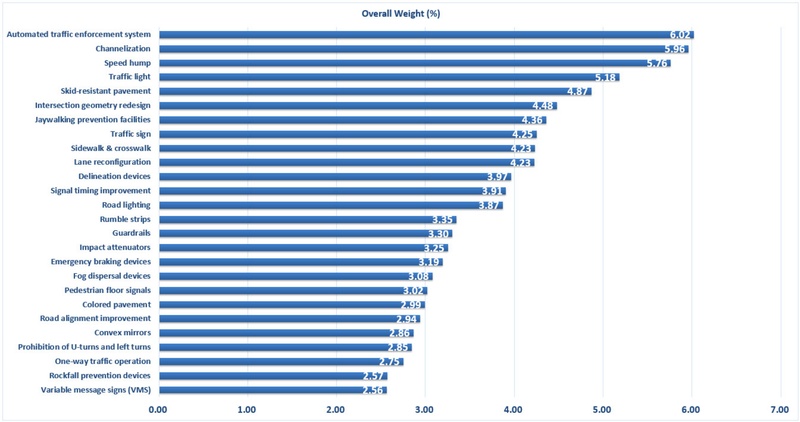
Prioritization results for traffic safety countermeasures
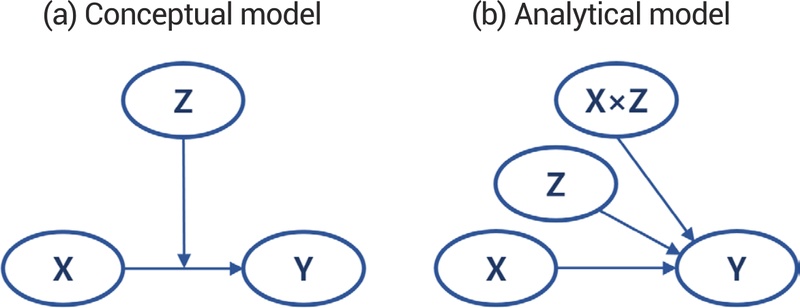
Moderated regression conceptual model
The moderated regression model applied in this study is expressed as in Equation (4).
| (4) |
In this study, 13 countermeasures were each set as independent variables, and 12 countermeasures, excluding the identical countermeasures, were entered as moderator variables, resulting in a total of 306 moderation models. To mitigate multicollinearity among variables and enhance the clarity of regression coefficient interpretation, mean centering was applied to the independent variables and moderator variables (Goldstein, 2010; Kelley et al., 2017). This is a common procedure that facilitates the interpretation of interaction terms by using the mean-subtracted value of each variable.
In addition, since heteroscedasticity was confirmed in the error term analysis, the HC3 (heteroscedasticity-consistent) robust standard error estimate was applied to ensure the reliability of the regression coefficients (White, 1980). In R, the significance of the coefficients was tested using the vcovHC (model type=“HC3”) option.
3. Analytical Data
The analytical data of the present study is based on the effect analysis data of the Accident-Prone Area Improvement Project. This project, which aims to improve road geometry and safety facilities to reduce recurring accidents at specific locations, has been conducted since the “Comprehensive Traffic Safety Plan” was established in 1987. Recently, a certain amount of design and construction has been implemented annually in accordance with the “Seventh Accident-Prone Area Improvement Project Plan (2022–2026)”.
The project is implemented in collaboration with the Office for Government Policy Coordination, the Ministry of Land, Infrastructure and Transport, the Ministry of the Interior and Safety, municipal governments, the National Police Agency, and the Korea Road Traffic Authority, and is conducted through the following procedures: accident data investigation and analysis, site selection, basic improvement plan development, improvement construction, and before-and-after effect evaluation. One cycle, from accident investigation to effect evaluation, takes approximately four years. For example, when the project is implemented based on accident data from 2024, the following steps are taken in the order of accident investigation in 2024, site selection and basic design in 2025, improvement construction in 2026, and effect evaluation in 2028 (accident statistics for 2027 will be compiled in 2028).
Accident-prone areas are selected based on a certain accident frequency occurring at the same location over the past year. As shown in <Figure 4>, the spatial boundary is 30 meters from the stop line at intersections and crosswalks, 200 meters for single-lane roads in urban road segments and 400 meters in rural road segments.
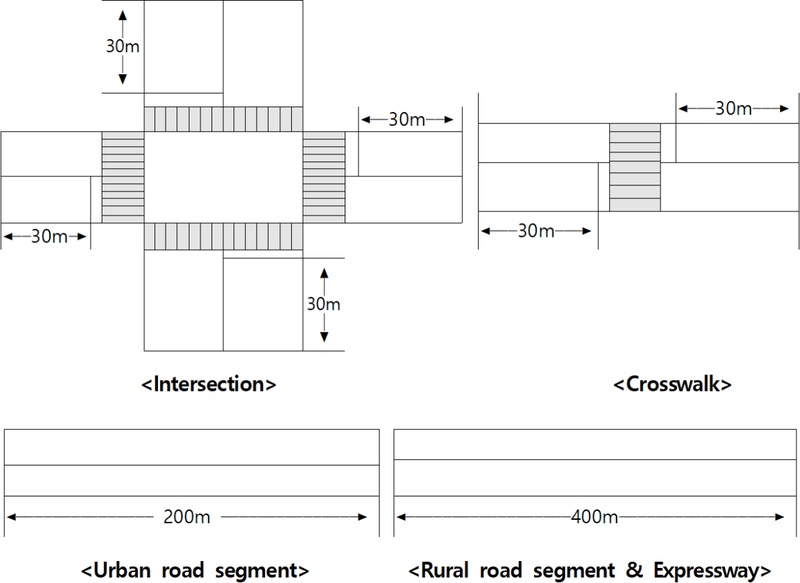
Spatial scope of the accident-prone area improvement program (MOCT, 2002)
According to the cumulative effect analysis from 1991 to 2024, the improvement project exhibited a certain level of safety improvement, such as a decrease in the accident frequency by approximately 28.9%, a decrease in the number of deaths by 45.3%, and a decrease in the number of injuries by 29.2% (Korea Road Traffic Authority, 2024b).
The analytical data for this study was compiled based on the “Accident-Prone Area Basic Improvement Plan and Effect Analysis” report published by the Korea Road Traffic Authority, covering the past 10 years (2015 to 2024). Of the 2,313 intersections for which the effect analyses were conducted, intersections unrelated to the 13 countermeasures analyzed in this study were excluded, leaving a total of 1,892 intersections (three-way and four-way intersections) for final analysis.
Countermeasure information was consolidated and organized into similar items, referencing the improvement-specific symbols in the report. For example, traffic signs (A00, A10, A21) and delineation devices (B91, B96) were grouped into the same category for analysis. Furthermore, the scale of countermeasures applied at each intersection was calculated by dividing the scale by the total number of access ways to the intersection, based on a drawing of the intersection in each direction. For example, in a three-way intersection where skid-resistant pavement was applied in two directions, the scale was calculated as 0.67.
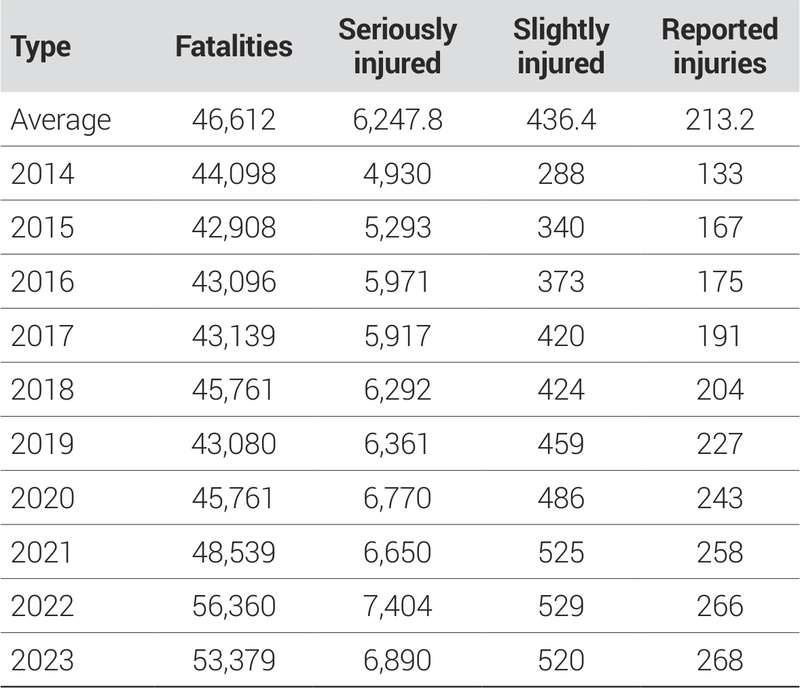
The dependent variables are the accident frequency and the accident severity. The accident frequency was obtained from the appendix of the report, and the accident severity was calculated using the unit cost of damage over the past 10 years presented in the Korea Road Traffic Authority's “Estimation and Assessment of Road Traffic Accident Costs” instead of the existing equivalent property damage only (EPDO) method (deaths×12, injuries×3). The weights were recalculated based on reported accidents (Table 3). As a result, the weights were 218.6 for deaths, 29.3 for serious injuries, 2.0 for minor injuries, and 1.0 for reported injuries.
Traffic accident costs by year and type of damage(unit: 10,000 KRW)
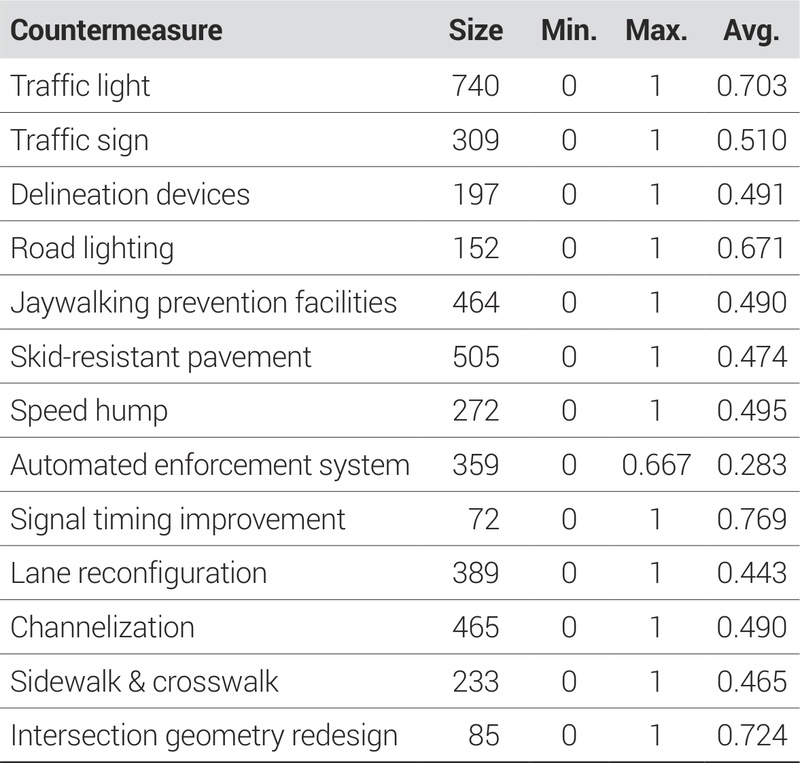
The regional distribution of the analysis data constructed through this process is shown in <Figure 5>, and among the 1,892 intersections, Seoul (11.2%) was the most common, followed by Gyeonggi (10.9%) and Gyeongbuk (8.0%). Furthermore, a total of 4,242 countermeasures were applied to the intersections analyzed, with an average of 2.2 countermeasures per intersection. While the number of countermeasures applied was high for traffic lights (740 locations) and skid-resistant pavement (505 locations), the number of countermeasures applied was relatively low for signal timing improvement (72 locations) (Table 4). The average scale of application by countermeasure was high for signal timing improvement (0.769) and intersection geometry redesign (0.724), while the average scale of application for the automated enforcement system (0.283) was the lowest.
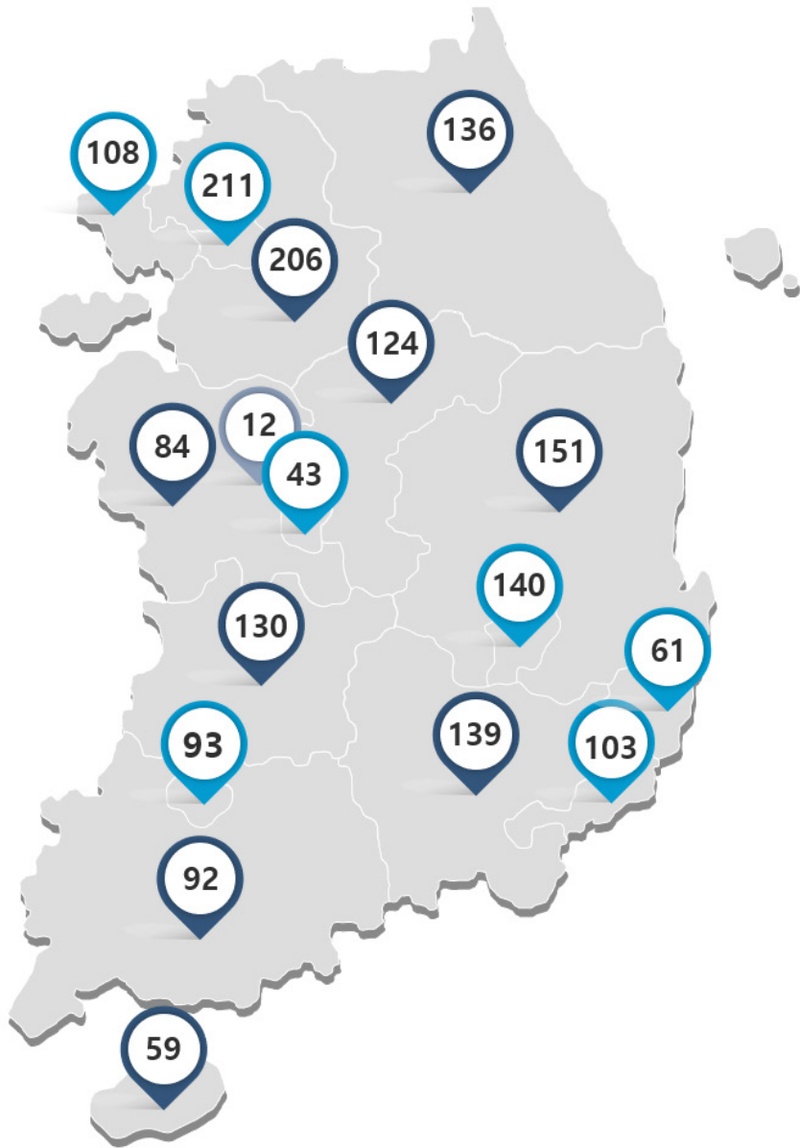
Distribution of intersections selected for analysis by region
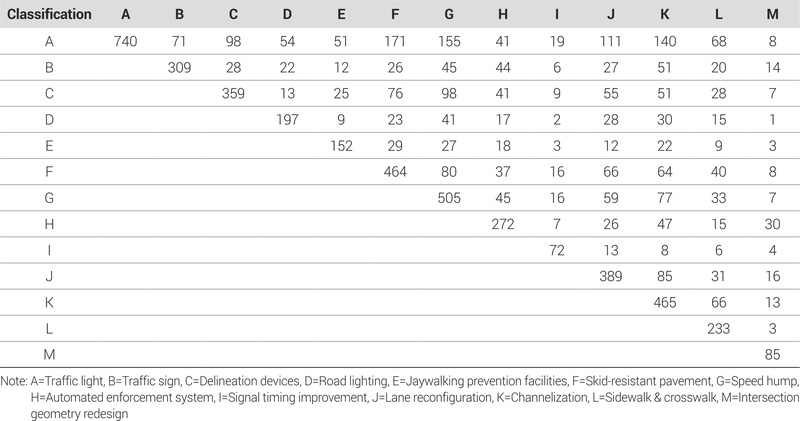
Furthermore, to precisely analyze the interaction effect according to the combined implementation, the sample size for each combination of countermeasures needs to be clearly presented. In this study, the application of all binary combinations of the 13 countermeasures was investigated, and the number of intersections for each combined implementation type was calculated separately. The sample size for each combination refers to the number of actual observations used to estimate the interaction term (X×Z) in the analysis model, and is different from the number of single countermeasures applied in <Table 4>. The sample size for each combined implementation type is presented in the <Appendix> to ensure the transparency and reproducibility of the study. In addition, when a specific combination was implemented in a very small scale (N<10), caution was taken in presenting the results in consideration of the possibility of interpretation bias.
Status of traffic safety countermeasures implemented at analyzed intersections
Ⅳ. Analytical Results
1. Analysis Overview and Model Suitability Review Results
The moderated regression analysis model was constructed using each of the 13 traffic safety countermeasures as a baseline and includes pairwise interaction terms with the remaining 12 countermeasures. The dependent variables were accident frequency and accident severity. While 156 models (13×12) are theoretically possible for each dependent variable, 153 models were analyzed, excluding combinations that are not present in the data, such as delineation devices–intersection geometry redesign and intersection geometry redesign–road lighting.
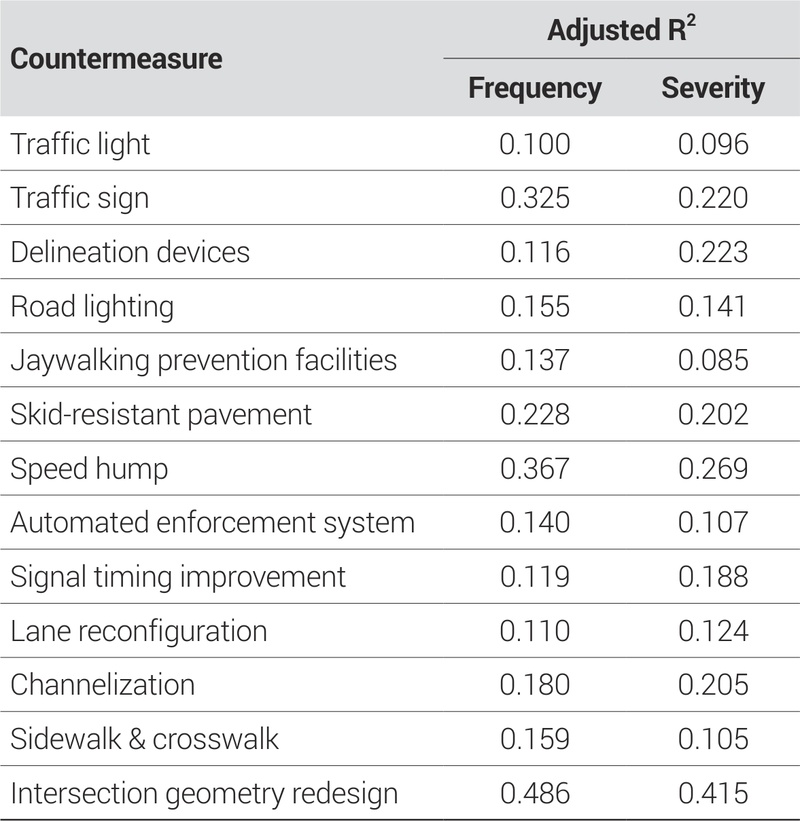
A goodness-of-fit test revealed that 282 of the 306 models (92.2%) were statistically significant (139 accident counts and 143 accident severity). Furthermore, as shown in <Table 5>, the adjusted R2 of the accident frequency models was generally higher than that of the accident severity models, confirming their relatively greater explanatory power for accident frequency.
R2 of a regression model
In this study, a “statistically significant model” was defined as one with an F-test significance level of less than 0.05. Meanwhile, considering the variability of actual traffic accident data, the omission of various external factors, and the structure of the regression model including interaction terms, the adjusted R2 of 0.1 to 0.4 is within the range generally observed in existing traffic safety model studies. Therefore, this study utilized the adjusted R2 as an indicator for comparison between models rather than as an absolute interpretation criterion, and policy discussions were centered on the F-test significance of the model and the statistical test results of the interaction terms.
2. Interpretation of Model Results
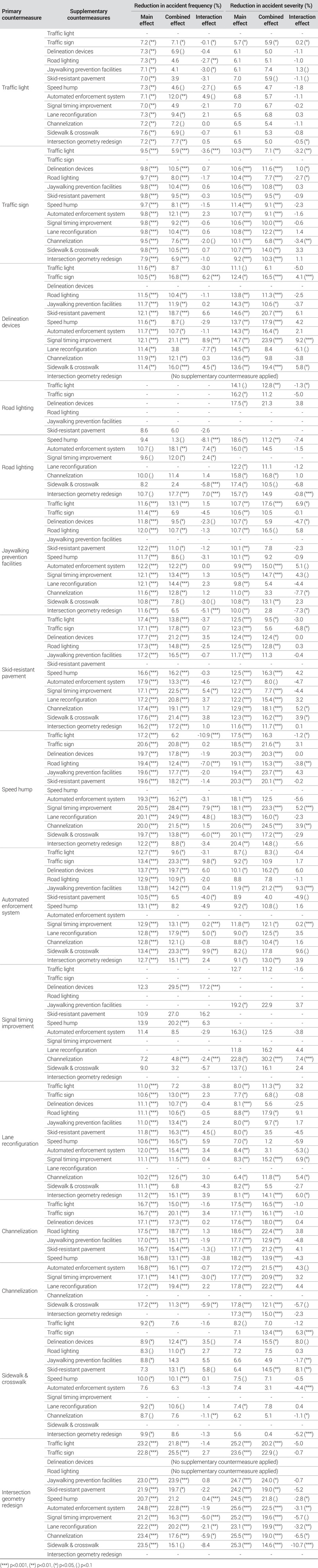
Analysis of the effects of single implementation of each countermeasure and the interaction effects of combined implementations revealed differences in the magnitude and direction of the effects across countermeasures. For most countermeasures, combined implementations showed either increased or decreased effects compared to single implementations, with statistical significance varying across countermeasures.
Traffic lights showed an accident reduction effect of approximately 7% in the case of single implementation, but this effect was somewhat reduced when combined with other countermeasures. Conversely, some combinations exhibited increased reductions when combined with an automated enforcement system or lane reconfiguration. Traffic signs showed a slightly lower average effect when implemented in combination, compared to single implementation, but their effect was rather enhanced when combined with delineation devices and sidewalks & crosswalks.
Overall, combined implementation of delineation devices, skid-resistant pavement, and lane reconfiguration tended to increase the effects of these countermeasures. Specifically, delineation devices demonstrated a greater effect in both accident frequency and accident severity compared to single implementation, with statistically significant increases observed in multiple combinations. Conversely, some measures, such as road lighting and speed hump, exhibited reduced effects in certain combinations.
Intersection geometry redesign demonstrated a high single implementation effect of approximately 20% or more on both accident frequency and accident severity, but its combined implementations reduced its effect in some combinations. However, combined implementation with traffic signs demonstrated a slightly increased accident frequency-reducing effect in some cases.
Meanwhile, some combinations exhibited asymmetric interaction effects. For example, when increasing the number of traffic lights was the primary strategy, installing an automated enforcement system enhanced the accident frequency-reducing effect. However, when an automated enforcement system was the primary strategy, the effects of increasing traffic lights were reduced. This inconsistent trend may be attributed to statistical and environmental factors, such as sample heterogeneity, multicollinearity between variables, and differences in implementation environments. Furthermore, even when the interaction term is statistically significant, the actual effect size may be minimal; therefore, interpretation requires considering both the effect size (%) and significance.
In summary, rather than categorically interpreting the direction of the effect of a specific combination, a cautious approach is required, taking into account data limitations and statistical variability. Further research conducted by controlling traffic environment characteristics is necessary for more robust conclusions. The final interaction analysis results are presented in <Table 6>.
Results of a moderated regression analysis by traffic safety countermeasures
The statistical test results for the interaction effect are presented in <Table 6>, but it is difficult to intuitively compare the relative magnitude and direction of the effects of each combination of countermeasures using the table format alone. Therefore, the interaction effect between accident frequency and accident severity was visualized for statistically significant combinations (p<0.05). <Figure 6> presents the interaction coefficients for the accident frequency-reducing effect and the accident severity-reducing effect, sorted by effect magnitude. The two figures clearly show whether a specific combination of countermeasures exhibits a synergistic effect (positive effect) or a reduced effect (negative effect) when implemented together, and complementarily visualize the interaction structure between countermeasures that would otherwise be difficult to grasp in a text-based interpretation.
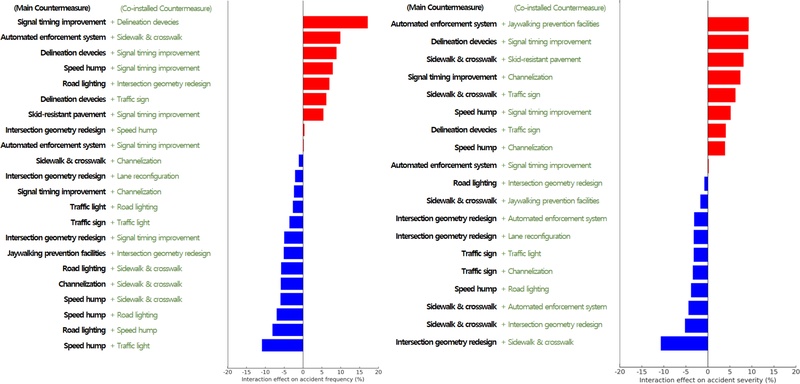
Significant interaction effects (p<0.05): accident frequency (left) and accident severity (right)
Meanwhile, the accident-prone area improvement project data used in this study compares the average accidents over the three years before and one year after the improvement; therefore, the presented accident reduction effect (%) is limited as being a relative indicator. Thus, for policy interpretation, supplementation is necessary to confirm the actual annual accident reduction rate. Furthermore, while it is internationally common to utilize active evaluation indicators that consider traffic volume, such as Annual Average Daily Traffic (AADT) and Million Vehicle Kilometers (MVK), the data used in this study did not include AADT and MVK, making them inapplicable. Future research should incorporate traffic environment variables such as traffic volume and geometry to conduct a more substantive analysis of the effects, including absolute reductions and traffic volume-adjusted indicators.
3. Results of Residual Diagnostics
In this study, the normality, homoscedasticity, and presence of extreme values in residuals, which are fundamental assumptions of regression analysis, were diagnosed for a total of 306 moderated regression models.
Normality was analyzed using Kline's (1998) skewness and kurtosis measures, commonly used in regression and structural equation models. All models met the criteria (skewness of 3 or less and kurtosis of 8 or less), demonstrating overall normality.
As mentioned in Chapter 3, homoscedasticity was tested by applying robust standard errors (Robust SE) during model building to address heteroscedasticity issues. The Breusch–Pagan test was then used to verify the criteria for all models, ensuring the stability of regression coefficient estimation and the reliability of interpretation.
Extreme values (standardized residuals exceeding 3) were within the standard range in all models, with the average extreme value rate being approximately 1.3%. This met the recommended criterion (less than 5% of the total sample), indicating no significant impact on model interpretation.
These results suggest that the moderated regression models constructed in this study generally meet statistical assumptions, and that interpretation of model estimates and policy discussions are reliable.
Ⅴ. Policy Recommendations and Conclusions
1. Policy Recommendations
Through the analytical results of this study, the effects of each traffic safety countermeasure applied alone were compared with the interaction effects when applied in combination with other countermeasures. This comparison showed whether positive or negative changes occurred in each combination of countermeasures, and effective implementation strategies for reducing accident frequency and severity were discussed.
For binary interactions of countermeasures, the difference between the single implementation effect and interaction effects of each combination was calculated and presented as a heat map, as shown in <Figure 7>. The change in effect in <Figure 7> indicates the magnitude of the interaction, which was calculated as "interaction effect – single implementation effect." In the heat map, positive interaction magnitudes are colored red (increased accident reduction effect), while negative ones are colored blue (decreased accident reduction effect).
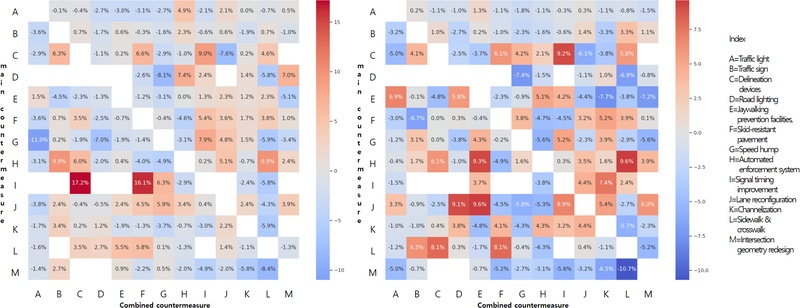
Heatmap of interaction effects between traffic safety countermeasures: interaction magnitude of accident frequency effects (left) and interaction magnitude of accident severity effects (right)
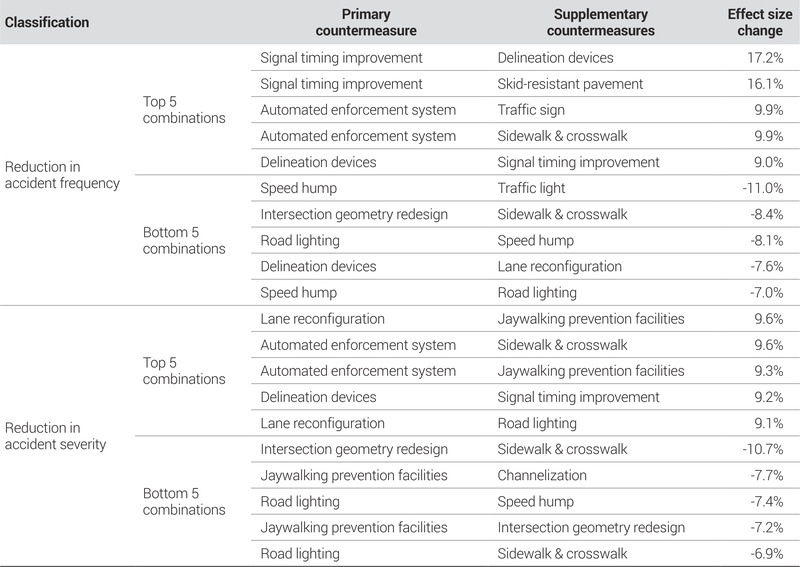
As shown in <Figure 7>, the magnitude of interaction varied depending on the combination of countermeasures. <Table 7> summarizes the top five and bottom five combinations of countermeasures by interaction effect magnitude, along with the resulting change in effect. These results confirm that some combinations of traffic safety countermeasures are relatively effective in reducing accident frequency and severity, while others are less effective.
Top/Bottom 5 traffic safety countermeasure combinations by interaction effect size
Based on the above analysis, three policy recommendations are proposed in this article for developing effective traffic safety improvement strategies.
First, a strategy that maximizes complementary effects should be adopted.
When signal timing improvement is applied as a primary countermeasure, the effect may be enhanced when combined with delineation devices or skid-resistant pavement. Furthermore, when an automated enforcement system is applied as a primary countermeasure, significant synergy effects have been observed when combined with traffic signs, sidewalks & crosswalks, and jaywalking prevention facilities. Therefore, it is advisable to give policy priorities to these combinations and apply them simultaneously.
Second, a non-combined strategy is needed to avoid mutual interference.
When a speed hump is used as a primary countermeasure, its effect may be diminished when combined with additional traffic signals. Furthermore, when road lighting is used as a primary countermeasure, its effect may also be diminished when used in combination with speed humps. Therefore, in these cases, combined implementations should be avoided, and a strategy that combines each countermeasure with other countermeasures is necessary.
Third, a customized combination strategy is needed according to safety improvement objectives.
The results in <Figure 7> demonstrate the effects of reducing accident frequency and accident severity. Therefore, goal-oriented combinations of countermeasures may be considered based on the accident characteristics at each location. For example, combining signal timing improvement with delineation devices or skid-resistant pavement can be expected to significantly reduce accident frequency. Similarly, combining automated enforcement system with jaywalking prevention facilities or sidewalks & crosswalks can be expected to significantly reduce accident severity.
Meanwhile, when discussing these policy implications, the statistical significance of the effects should be considered in addition to the magnitude of the regression coefficients. Statistically insignificant reduction effects cannot be ruled out because they may be the result of within-sample variation. Therefore, it is more appropriate to understand them as a reference-level tendency rather than as a basis for policy. Complementarily applying these perspectives can further enhance the reliability of policy recommendations and the consistency of interpretation based on the model results.
2. Conclusions
This study analyzed the interaction effects among 13 countermeasures, considering the characteristics of various countermeasures being applied in combination to traffic safety projects in Korea. Specifically, the accident frequency-reducing effect and the accident severity-reducing effect that occur when each countermeasure is combined with others were quantified.
To this end, data from accident-prone area improvement projects over the past 10 years were used to collect data on the scale of countermeasure application and accident data before and after improvement at 1,892 intersections. Moderated regression analysis models were used to identify single implementation effects and interaction effects.
The main results are as follows. First, 282 of the 306 models were statistically significant, confirming the presence of interaction effects by combined implementation. Second, the explanatory power of the accident frequency model was higher than that of the accident severity model, confirming that the influence of the combination of countermeasures was relatively stronger on accident frequency. Third, there were numerous cases where the combined implementation enhanced or weakened the effects compared to single implementations. On average, delineation devices, automated enforcement systems, signal timing improvement, and sidewalks & crosswalks strengthened both the accident frequency-reducing effects and the accident severity-reducing effect, whereas traffic lights, traffic signs, jaywalking prevention facilities, speed humps, and intersection geometry redesign tended to weaken the effects.
Furthermore, the accident reduction effect derived from this study was lower than in previous studies. This is interpreted as a result of the precise examination of the scale of countermeasures applied at each intersection access way. This allowed for a comparison of the relative effect of the 13 countermeasures frequently applied to traffic safety projects in Korea. Furthermore, the analysis newly identified the interaction effects of combined applications, which were difficult to identify in previous studies.
However, since this study focused on interrupted flow sections centered on intersections, the results may be influenced by the physical and traffic characteristics of the target intersections (e.g., urban/rural ratio, intersection shape, countermeasure application patterns). Therefore, direct generalization of these results to uninterrupted flow sections or other diverse traffic environments is limited. Future studies may need to be conducted on expanded analyses that incorporate diverse regions and traffic flow characteristics.
Furthermore, the negative interaction effects observed in some combinations may be due to complex factors, including design conflicts between countermeasures, increased driver cognitive load, and desensitization due to repetition and overlapping. Considering these factors, the combined application of countermeasures should be carefully carried out, taking into account not only the simple summation of countermeasures but also the implementation environment, driving characteristics, and driver responses. Future research should more precisely propose policy and design improvements, such as design methods that minimize negative interactions and facility layout principles that reduce driver cognitive load.
This study analyzed the single implementation effects of various traffic safety countermeasures and the interaction effects of their combined implementation, suggesting improvement strategies. However, the present study has the following limitations.
First, the analysis method relies on a simple before-and-after comparison, making it difficult to completely eliminate the problem of regression to the mean. Future research should address this limitation through sophisticated analyses utilizing multi-year time-series data.
Second, traffic accidents are complexly influenced by various external factors, including weather conditions, driver behavior, time of day, land use characteristics, and road congestion. However, data limitations prevented this from being reflected in the regression model of this study. Future research should employ multi-faceted analyses that consider traffic environment variables such as driver characteristics and spatial factors to precisely identify the causes of differences in the effect among countermeasures.
Third, due to limitations in accident data and facility application history, important traffic environment variables such as road geometry, traffic volume (AADT), and traffic flow type (interrupted/uninterrupted) were not included in the model. These variables may alter the magnitude and direction of the effects of countermeasures. Therefore, future research should systematically verify the combined implementation effects through interaction analyses of traffic environment variables or through subdivided models based on traffic characteristics.
Finally, this study focused on an exploratory analysis of the combined implementation effects of countermeasures, suggesting combination strategies based on the magnitude and statistical significance of interaction effects. Future use of artificial intelligence-based predictive models or nonlinear models to quantify the differences in the effect across countermeasure combinations will increase their practical applicability, such as in packaged road safety project planning.
Acknowledgments
This article was written by revising and supplementing some of the contents of Yang Jeong-hun's doctoral thesis at Chungbuk National University.
Notes
References
- AASHTO, 2010. Highway Safety Manual, WA: AASHTO.
-
Al-Marafi, M.N., Alhadidi, T.I., Alhawamdeh M., and Jaber, A., 2024. “Enhancing Road Safety Strategies through Applying Combined Treatments for Different Crash Severity”, Urban Science, 8(3): 109.
[https://doi.org/10.3390/urbansci8030109]

-
Baek, S.Y., 2012. “A Study on Preventive Measures for Traffic Accidents Resulting from Jaywalking – Focusing on Crosswalks and Pedestrian Crossing Prevention Facilities”, Ph.D. Dissertation, University of Seoul.
백승엽, 2012. “무단횡단교통사고 예방대책에 관한 연구 – 횡단보도 및 무단횡단 방지시설을 중심으로”, 서울시립대학교 박사학위 논문. -
Baron, R.M. and Kenny, D.A., 1986. “The Moderator–Mediator Variable Distinction in Social Psychological Research: Conceptual, Strategic, and Statistical Considerations”, Journal of Personality and Social Psychology, 51(6): 1173-1182.
[https://doi.org/10.1037//0022-3514.51.6.1173]
-
Biswas, P., Kang, M.W., and Rahman, M., 2024. “Safety Evaluation of the Combined Effect of Offset Left-Turn Lanes and Flashing-Yellow-Arrow Signals at Signalized Intersections on Multilane Divided Highways in Alabama Using the Empirical Bayes Method”, Transportation Research Record: Journal of the Transportation Research Board, 2678(8): 31-45.
[https://doi.org/10.1177/03611981231213076]
-
Byaruhanga, C.B. and Evdorides, H., 2022. “A Comparison between Crash and Casualty Economic Analysis Approaches Of Road Safety Infrastructure Countermeasures”, International Journal of Traffic and Transport Engineering, 12(1): 49-60.
[https://doi.org/10.7708/ijtte2022.12(1).04]
-
Chen, L., Chen, C., Ewing, R., McKnight, C.E., Srinivasan R., and Roe, M., 2013. “Safety Countermeasures and Crash Reduction in New York City—Experience and Lessons Learned”, Accident Analysis & Prevention, 50: 312-322.
[https://doi.org/10.1016/j.aap.2012.05.009]
-
Choi, J.H., Im, J.B., and Lee, S.B., 2016. “A Meta Analysis of the Effects of Road Safety Facilities on Accident Reduction: Focusing on Signalized Intersection”, Journal of Korean Society of Transportation, 34(4): 291-303.
[https://doi.org/10.7470/jkst.2016.34.4.291]
최지혜·임준범·이수범, 2016. “도로안전시설의 사고감소효과 메타분석: 신호교차로를 대상으로”, 「대한교통학회지」, 34(4): 291-303. -
Cohn, E.G., Kakar, S., Perkins, C., Steinbach R., and Edwards, P., 2020. “Red Light Camera Interventions for Reducing Traffic Violations and Traffic Crashes: A Systematic Review”, Campbell Systematic Reviews, 16(2): e1091.
[https://doi.org/10.1002/cl2.1091]
- Das, S., Sun, X., He, Y., Wang F., and Leboeuf, C., 2013. “Investigating the Safety Impact of Raised Pavement Markers on Freeways in Louisiana”, International Journal of Engineering Research and Innovation, 5(2): 74-80.
-
Elvik, R., 2017. “Road Safety Effects of Roundabouts: A Meta-Analysis”, Accident Analysis & Prevention, 99: 364-371.
[https://doi.org/10.1016/j.aap.2016.12.018]
-
Goldenbeld, C., Daniels, S., and Schermers, G., 2019. “Red Light Cameras Revisited. Recent Evidence on Red Light Camera Safety Effects”, Accident Analysis & Prevention, 128: 139-147.
[https://doi.org/10.1016/j.aap.2019.04.007]
-
Goldstein, H., 2010. Multilevel Statistical Models (4th ed.), Oxford: Wiley.
[https://doi.org/10.1002/9780470973394]
- Gorthy, S.C., 2017. “Analysis of Right-In, Right-Out Commercial Driveway Safety, Operations and Use of Channelization as Compliance Countermeasure”, Master’s Thesis, Clemson University.
-
Gyaase, D., Newton, S., Adams, C.A., Enuameh, Y., Adjei, B.N., and Nakua, E.K., 2023. “Effect of Speed Humps on Injury Consequences on Trunk Roads Traversing Towns in Ghana: A Quasi-experimental Study”, Injury Prevention, 29(1): 68-73.
[https://doi.org/10.1136/ip-2022-044598]
-
Han, S.J., Park, B.J., and Yoon, G.H., 2004. “Introduction to Areawide Road Safety Improvement Programs”, Journal of Korean Society of Transportation, 22(5): 47‑57.
한상진·박병정·윤공현, 2004. “면차원 도로안전 개선사업의 도입방안 연구”, 「대한교통학회지」, 22(5): 47-57. - Hauer, E., 1997. Observational Before/After Studies in Road Safety. Estimating the Effect of Highway and Traffic Engineering Measures on Road Safety, NY: Elsevier Science Incorporated.
- Hayes, A.F., 2018. Introduction to Mediation, Moderation, And Conditional Process Analysis: A Regression-Based Approach (2nd ed.), NW: Guilford Press.
-
Helm, R. and Mark, A., 2012. “Analysis and Evaluation of Moderator Effects in Regression Models: State of Art, Alternatives and Empirical Example”, Review of Managerial Science, 6(4): 307-332.
[https://doi.org/10.1007/s11846-010-0057-y]
-
Hong, S.H. and Jung, S., 2014. “Testing the Interaction Effects in Regression and Structural Equation Models: Theories and Procedures”, The Korean Journal of Human Development, 21(4): 1-24.
[https://doi.org/10.15284/kjhd.2014.21.4.1]
홍세희·정송, 2014. “회귀분석과 구조방정식 모형에서의 상호작용효과 검증: 이론과 절차”, 「인간발달연구」, 21(4): 1-24. - Hovey, P.W. and Chowdhury, M.A. 2005. Development of Crash Reduction Factors, WS: Federal Highway Administration.
-
Im, J.K., Sul, J.H., Park, J.U., Sung, N.M., Choi, J.S., and Hyun, J.W., 2016. Effects and Improvements on Highway Safety Projects in Korea, Sejong: The Korea Transport Institute.
임재경·설재훈·박정욱·성낙문·최재식·현진우, 2016. 「도로교통 안전사업의 효과 분석 및 제도적 개선방안」, 세종: 한국교통연구원. - Jami, N., 2011. “LED Traffic Signal Retrofits: Implications for Intersection Safety”, Master’s Thesis, The University of Memphis.
-
Kelley, J., Evans, M.D.R., Lowman, J., and Lykes, V., 2017. “Group-mean-centering Independent Variables in Multi-level Models is Dangerous”, Quality & Quantity, 51(1): 261-283.
[https://doi.org/10.1007/s11135-015-0304-z]
-
Ki, H.S. and Kim, E.C., 2023. “A Study on the Influence of Triangular Islands on Intersection Traffic Crashes: Focusing on Incheon Metropolitan City”, Journal of Korean Society of Transportation, 41(1): 119-134.
[https://doi.org/10.7470/jkst.2023.41.1.119]
기한솔·김응철, 2023. “삼각교통섬이 교차로 교통사고에 미치는 영향 연구: 인천광역시를 중심으로”, 「대한교통학회지」, 41(1): 119-134. -
Kim, B.E. and Lee, Y.I., 2011. “Impacts of Pre-signals on Traffic Crashes at 4-leg Signalized Intersections – Focusing on Four-way Intersections –”, Paper presented at the 2011 Korean ITS Fall Conference, 255-263.
김병은·이영인, 2011. “전방신호기 설치가 교통사고에 미치는 영향 연구 – 4지교차로 중심으로 –”, 2011년 한국ITS학회 추계학술대회, 255-263. - Kline, R.B., 1998. Principles and Practice of Structural Equation Modeling, New York, NY: Guilford Press.
-
Korea Road Traffic Authority, 2024a. Estimation and Evaluation of Road Traffic Accident Costs (by Year), Wonju.
한국도로교통공단, 2024a. 「연도별 도로교통 사고비용의 추계와 평가」, 원주. -
Korea Road Traffic Authority, 2024b. Basic Improvement Plans and Effectiveness Analysis for High-Frequency Traffic Accident Locations (by Year), Wonju.
한국도로교통공단, 2024b. 「연도별 교통사고 잦은 곳 기본개선계획 및 효과분석」, 원주. -
Kwak, H.J., 2020. “Safety Evaluation of Multiple Treatments for Expressway Ramp”, Journal of Korean Society of Transportation, 38(6): 452-461.
[https://doi.org/10.7470/jkst.2020.38.6.452]
곽현준, 2020. “고속도로 램프부 교통안전개선대책 사고감소효과 평가”, 「대한교통학회지」, 38(6): 452-461. -
Kwak, K.Y., 2023. Statistical Data Analysis Using R, Seoul: Cheongram Publishing Co.
곽기영, 2023. 「R을 이용한 통계데이터분석」, 서울: 도서출판 청람. -
Kwon, S.K., Lee, Y.I., and Cho, S.J., 2012. “Estimation of Traffic Accident Effectiveness of Zig-zag Marking Using a Comparison Group Method”, International Journal of Highway Engineering, 14(6): 149-158.
[https://doi.org/10.7855/IJHE.2012.14.6.149]
권성근·이영인·조성준, 2012. “CG Method를 이용한 지그재그 노면표시의 교통사고 감소효과 분석”, 「한국도로학회논문집」, 14(6): 149-158. -
Lee, D.M., Kang, J.H., Sung, N.M., and Jeong, B.J., 2007. “A Safety Evaluation of Shoulder Rumble Strips on Freeway Using C-G Method”, International Journal of Highway Engineering, 9(2): 77-87.
이동민·강재홍·성낙문·정봉조, 2007. “C-G Method 를 이용한 고속도로 노면요철 포장의 교통사고감소 효과분석”, 「한국도로학회논문집」, 9(2): 77-87. -
Lee, D.M., Kim, D.H., and Song, K.S., 2011. “Analysis of Effects from Traffic Safety Improvement on Roadways using C-G Method”, Journal of Korean Society of Transportation, 29(3): 31-40.
이동민·김도훈·송기섭, 2011. “비교그룹방법을 이용한 교통안전 시설물 설치 효과 분석”, 「대한교통학회지」, 29(3): 31-40. -
Lee, M.H., Choi, K.J., Oh, I.S., and Kim, J.H., 2015. “Analysis of Traffic Accident Reduction Performance of High-quality and Long-life Pavement Marking Materials”, Journal of Civil and Environmental Engineering Research, 35(4): 921-929.
[https://doi.org/10.12652/Ksce.2015.35.4.0921]
이명환·최기주·오인섭·김정화, 2015. “고기능·장수명 차선도료의 교통사고 감소효과 분석”, 「대한토목학회논문집」, 35(4): 921-929. -
Lim, J.S. and Han, S.J., 2024. “Analysis of Safety Effects of Color Guide Markings at the At-Grade Intersection”, Traffic Safety Research, 43(1): 155-174.
임진섭·한상진, 2024. “평면교차로 내 노면색깔유도선의 사고감소 효과분석”, 「교통안전연구」, 43(1): 155-174. -
Ma, J., Fontaine, M.D., Zhou, F., Hu, J., Hale D.K., and Clements, M.O., 2016. “Estimation of Crash Modification Factors for an Adaptive Traffic Signal Control System”, Journal of Transportation Engineering, 142(12): 04016061.
[https://doi.org/10.1061/(ASCE)TE.1943-5436.0000890]
-
Maeng, G.Y., 2024. “A Study on the Safety Effectiveness of Crash Improvement Projects at Black Spot Using Empirical Bayes Method”, Master’s Thesis, Myongji University.
[https://doi.org/10.7470/jkst.2024.42.6.649]
맹기영, 2024. “경험적 베이즈 방법을 활용한 교통사고 잦은 곳 개선사업 시설물 사고감소 효과분석”, 명지대학교 석사학위 논문. - Merritt, D.K., Lyon, C., Persaud, B., and Torres, H.N., 2020. Developing Crash-Modification Factors for High-Friction Surface Treatments, WS: Federal Highway Administration.
-
Ministry of Construction and Transportation, 2002. Business Handbook for Accident-Prone Area Improvement Project, Gwacheon.
건설교통부, 2002. 「사고 잦은 곳 개선사업 업무편람」, 과천. -
Ministry of Land, Infrastructure and Transport, 2019. Guidelines for Installation and Management of Traffic Calming Facilities, Sejong.
국토교통부, 2019. 「교통정온화 시설 설치 및 관리지침」, 세종. -
Ministry of Land, Infrastructure and Transport, 2024. 2024 Annual Report on Traffic Safety, Sejong.
국토교통부, 2024. 「2024 교통안전 연차보고서」, 세종. -
Montella, A., 2009. “Safety Evaluation of Curve Delineation Improvements: Empirical Bayes Observational Before-and-After Study”, Transportation Research Record: Journal of the Transportation Research Board, 2103(1): 69-79.
[https://doi.org/10.3141/2103-09]
-
Nishiuchi, H., Dias C., and Kawato, S., 2023. “Empirical Evaluation of Change in Crash Risk due to Lane Marking rEallocation: A Case Study in Kochi City, Japan”, IATSS Research, 47(4): 535-544.
[https://doi.org/10.1016/j.iatssr.2023.12.001]
-
Nye, T. and Simpson, C., 2024. “Safety Evaluation of Dual Left-Turn Lane Installations in North Carolina”, Transportation Research Record: Journal of the Transportation Research Board, 2678(10): 1239-1251.
[https://doi.org/10.1177/03611981241236791]
- Obeidat, M.S. and Rys, M.J., 2016. “Intersection Lighting Impacts on Nighttime Crashes Reduction and Safety Improvement,” Paper presented at the TRB 2016 Annual Meeting, Washington DC.
-
Park, B.H., 2014. “Analysis of Traffic Accident Reduction Effect Before and After Signal Operation System Improvement Projects”, Journal of the Institute of Construction Technology, 33(2): 21-25.
박병호, 2014. “신호운영체계 개선사업 전, 후 신호위반 사고 감소효과 분석”, 「건설기술논문집」, 33(2): 21-25. -
Park, G.Y., Kim, T.H., Kim, S.W., and Lee, S.B., 2006. “Comparing the Effectiveness of Road Safety Features by Spatial Scope of Safety Improvement Project”, Journal of Korean Society of Transportation, 24(4): 31-42.
박규영·김태희·김성욱·이수범, 2006. “도로안전개선사업의 공간적 범위에 따른 도로안전시설물의 효과도 비교”, 「대한교통학회지」, 24(4): 31-42. -
Park, S.N., Im, J.B., Kim, D.I., Kim, J.H., and Choi, M.H., 2016. “Estimation of Traffic Accident Effectiveness of White Left Shoulder Line Using a Comparison Group Method”, International Journal of Highway Engineering, 18(5): 127-134.
[https://doi.org/10.7855/IJHE.2016.18.5.127]
박시내·임준범·김동인·김진홍·최명호, 2016. “비교그룹방법을 통한 백색 중앙분리대측 실선 도입의 사고감소효과 연구”, 「한국도로학회논문집」, 18(5): 127-134. -
Park, Y.W. and Park, S.H., 2021. “Analysis on the Effect of Jaywalking Prevention Facilities Using Cluster Analysis and Empirical Bayes Method”, Traffic Safety Research, 40: 123-133.
박용우·박신형, 2021. “군집분석과 경험적 베이즈 방법을 활용한 무단횡단 금지시설 설치 효과 분석”, 「교통안전연구」, 40: 123-133. - Persaud, B.N., 2001. Statistical Methods in Highway Safety Analysis, WA: Transportation Research Board.
-
Pratelli, A., Lupi, M., Pratelli, C., and Farina, A., 2020. “Mini-roundabouts for Improving Urban Accessibility”, In Modelling of the Interaction of the Different Vehicles and Various Transport Modes, Edited by Sładkowski, A., 333–382, Springer International Publishing.
[https://doi.org/10.1007/978-3-030-11512-8_8]
-
Putra, I.G.B., Kuo P.F., and Lord, D., 2024. “Estimating the Effectiveness of Marked Sidewalks: An Application of the Spatial Causality Approach”, Accident Analysis & Prevention, 206: 107699.
[https://doi.org/10.1016/j.aap.2024.107699]
- Rahman, M., Hoang-Tung, N., Kojima, A., and Kubota, H., 2017. “Identification of External Factors Affecting the Effectiveness of Speed Humps”, Journal of the Eastern Asia Society for Transportation Studies, 12: 2016-2034.
-
Reyad, P., Sayed, T., Essa, M., and Zheng, L., 2022. “Real-Time Crash-Risk Optimization at Signalized Intersections”, Transportation Research Record: Journal of the Transportation Research Board, 2676(12): 32-50.
[https://doi.org/10.1177/03611981211062891]
-
Rothman, L., Macpherson, A., Buliung, R., Macarthur, C., To, T., Larsen K., and Howard, A., 2015. “Installation of Speed Humps and Pedestrian-motor Vehicle Collisions in Toronto, Canada: A Quasi-experimental Study”, BMC Public Health, 15(1): 774.
[https://doi.org/10.1186/s12889-015-2116-4]
-
Severino, A., Pappalardo, G., Curto, S., Trubia S., and Olayode, I.O., 2021. “Safety Evaluation of Flower Roundabout Considering Autonomous Vehicles Operation”, Sustainability, 13(18): 10120.
[https://doi.org/10.3390/su131810120]
-
Shen, J. and Gan, A., 2003. “Development of Crash Reduction Factors: Methods, Problems, and Research Needs”, Transportation Research Record: Journal of the Transportation Research Board, 1840(1): 50-56.
[https://doi.org/10.3141/1840-06]
-
Stevanovic, A., Stevanovic, J., and Kergaye, C., 2013. “Optimization of Traffic Signal Timings Based on Surrogate Measures of Safety”, Transportation Research Part C: Emerging Technologies, 32: 159-178.
[https://doi.org/10.1016/j.trc.2013.02.009]
-
Tang, H., Gayah, V.V., and Donnell, E.T., 2020. “Crash Modification Factors for Adaptive Traffic Signal Control: An Empirical Bayes Before-after Study”, Accident Analysis & Prevention, 144: 10567.
[https://doi.org/10.1016/j.aap.2020.105672]
-
Tilahun, N., 2023. “Safety Impact of Automated Speed Camera Enforcement: Empirical Findings Based on Chicago’s Speed Cameras”, Transportation Research Record: Journal of the Transportation Research Board, 2677(1): 1490-1518.
[https://doi.org/10.1177/03611981221104808]
-
Valderrama, S.L., Palacios, M.S., Botello, V.P., Perez-Barbosa, D., Arrieta, J.V., Kisner J., and Adriazola-Steil, C., 2024. “On Speed Management, Public Health, and Risky Behaviors: Examining the Side Effects of Automated Speed-Enforcement Cameras on Traffic Crashes in Bogotá, Colombia”, Transportation Research Record: Journal of the Transportation Research Board, 2678(3): 590-600.
[https://doi.org/10.1177/03611981231182419]
-
Vingilis, E., 2016. “Conceptual and Methodological Issues in Evaluations of Road Safety Countermeasures”, Safety, 2(1): 8.
[https://doi.org/10.3390/safety2010008]
- Von Quintus, H.L. and Mergenmeier, A., 2015. Case Study: Kentucky Transportation Cabinet’s High Friction Surface Treatment and Field Installation Program, WA: Federal Highway Administration.
- Werner, T., 2015. “Do Speed Humps Help Reduce Vehicular Speeds, Volumes, and Motorist Accidents”, Master’s Thesis, San Jose State University.
-
White, H., 1980. “A Heteroskedasticity-consistent Covariance Matrix Estimator and a Direct Test for Heteroskedasticity”, Econometrica, 48(4): 817-838.
[https://doi.org/10.2307/1912934]
-
Williamson, M. and Lin, P., 2023. Effectiveness of Contrast Markings on Roadways and Orange Markings in Work Zones, IN: Purdue University.
[https://doi.org/10.5703/1288284317683]
-
Yang, R., Wang, Z., Lin, P.S., Li, X., Chen, Y., Hsu, P.P., and Henry, A., 2019. “Safety Effects of Street Lighting on Roadway Segments: Development of a Crash Modification Function”, Traffic Injury Prevention, 20(3): 296-302.
[https://doi.org/10.1080/15389588.2019.1573317]
-
Yoon, G.H., Baek, S.H., Lee, G.M., and Choi, B.H., 2017. “Case Study on the Improvement of Vulnerable Section of Pedestrian Safety: Focusing on No trespassing Facilities and Pedestrian Traffic Island”, Paper presented at the 76th Korean Society of Transportation Conference.
윤공현·백상훈·이강무·최병호, 2017. “보행자 교통안전 취약구간 개선사업 사례연구: 무단횡단금지시설 및 보행교통섬을 중심으로”, 대한교통학회 제76회 학술발표회. -
Yoon, Y.I., 2016. “Estimation of Traffic Accident Reduction Effect on Road Safety Facilities”, Master’s Thesis, University of Seoul.
윤여일, 2016. “도로안전 관련 시설물 교통사고 감소효과도 추정”, 서울시립대학교 석사학위 논문. -
Zhang, Y., Li, H., and Ren, G., 2023. “Road sSafety Evaluation with Multiple Treatments: A Comparison of Methods Based on Simulations”, Accident Analysis & Prevention, 190: 107170.
[https://doi.org/10.1016/j.aap.2023.107170]
-
Zhou, Y., Himes, S., Le, T., Gooch, J., Northup, K., and Pavao, P., 2022. “Safety Effectiveness of the Road Diet Treatment in Rhode Island”, Transportation Research Record: Journal of the Transportation Research Board, 2676(7): 24-31.
[https://doi.org/10.1177/03611981221076433]
- Zlatkovic, M., 2019. Development of Performance Matrices for Evaluating Innovative Intersections and Interchanges MPC-19-391, Mountain-Plains Consortium, Department of Civil & Architectural Engineering University of Wyoming.
Appendix
Appendix
Sample size by combination of traffic safety countermeasures